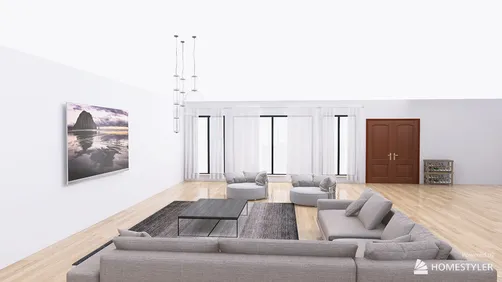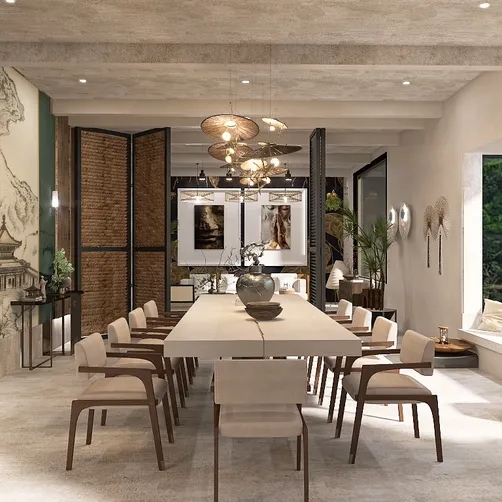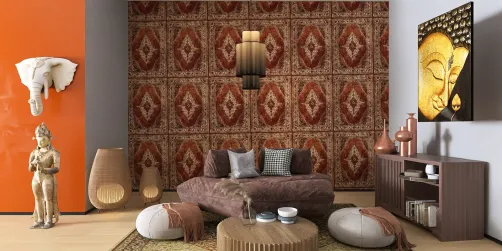
As the future approaches, modern households face the challenges of hybrid work environments, multi-generational dynamics, and ever-growing storage needs. I view a 3BHK first-floor plan spanning 1125 square feet as an initial framework for this evolving reality. Based on data from the NAHB survey, over half of prospective buyers seek versatile spaces that can transition from office to guest accommodations. Thus, the layout should be adaptable, capable of updating with life's evolving demands. This 3BHK design acts as an operating system where rooms efficiently manage functionality rather than merely focusing on square footage, incorporating tools for spatial reasoning into its architecture.
Linear Spine with Dual Nodes
Design Logic: A central corridor serves as a structural backbone, connecting three bedrooms while anchoring the living and dining areas at one end. This layout emphasizes modular privacy, effectively distinguishing between daytime and nighttime zones.
Flow: Begin your journey at the entry → move through a foyer buffer → reach the living hub → transition to the dining/kitchen junction → navigate the corridor → access bedrooms → and finish at the bathrooms, with a guest/office area near the entry for flexible hosting options.
Sightlines: A clear line of sight from the front door to the balcony establishes a coherent axis; additional views are strategically staggered to minimize visual disruption in workspaces, maintaining a clear UI hierarchy.
Storage: Depth-focused closets along the corridor act as caches, accompanied by pull-out kitchen pantries and under-bed drawers to create a predictable and efficient retrieval process.
Furniture Fit: A full-length sofa of 84 inches, a dining table measuring 72 by 36 inches, and queen-sized beds at 60 by 80 inches provide ample space. A desk alcove that is 48 inches wide harmonizes with circulation freedom, ensuring functionality.
Verdict: This spine-like layout can be scaled effectively; distinct nodes are ready to manage future functions like remote work and small gatherings without conflicts.
save pin
Courtyard Core with Perimeter Rooms
Design Logic: A central lightwell or balcony acts as the processing unit, channeling natural light like valuable data to the surrounding rooms—perfectly suited to make the 1125 square feet feel more expansive.
Flow: Navigate from the entry → around the central living space → to an adjacent kitchen → through a ring corridor → accessing three perimeter bedrooms → and clustered bathrooms for efficient plumbing.
Sightlines: The view hierarchy prioritizes the courtyard sky, with secondary focus on doors; the thresholds function effectively as menu headers to ease cognitive load.
Storage: Built-in perimeter solutions serve as a circular cache: wardrobes with an depth of 18 inches, corner linen towers, and bench storage centrally located for daily essentials.
Furniture Fit: A 96-inch sectional with a chaise hugs the core edge; the master bedroom accommodates a king-sized bed if measuring 11 by 12 feet; while a child's room can fit a bunk bed of 78 inches high without obstructing flow.
Verdict: By centralizing light and social bandwidth, the home supports future activities—quick meetings, long family dinners, or peaceful resets—without fragmenting the environment.
save pin
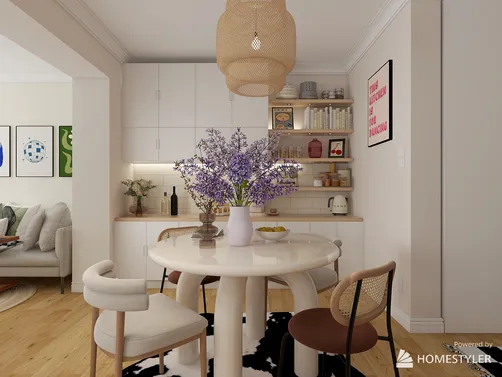
Split-Zone with Pocket Flex Room
Design Logic: The design separates the daytime area (living, dining, kitchen) from the nighttime zone at the rear, featuring a flex room that transforms from an office into a guest space as needed.
Flow: Enter and move to the open living/dining area → follow to the L-shaped kitchen → slide through the partition into the flex room → progress to the rear corridor → leading to two bedrooms → and shared or ensuite bathrooms to minimize traffic.
Sightlines: A long view stretches from the living area to the rear window, while controlled side views are managed; partitions function as modal dialogues—open when necessary and quiet otherwise.
Storage: A dual-layer cache includes overhead kitchen cabinets and toe-kick drawers; a 12-inch deep niche in the hallway provides space for seasonal items; and the flex room includes a wardrobe on rails.
Furniture Fit: A round dining table for four fits perfectly at 48 inches; a sleeper sofa in the flex space measures 72 inches; the master dresser at 60 inches maintains a 36-inch circulation corridor.
Verdict: The flex room is designed to adapt, allowing for changes in functionality—whether as a startup workspace, accommodation for visiting family, or nursery space—without needing an overhaul of the entire layout.
save pin
Final Takeaway
A 3BHK first-floor plan within 1125 square feet emphasizes functionality over mere size, seamlessly integrating varied lifestyles into well-designed interfaces. Through intelligent zoning, adaptable flex rooms, and efficient storage solutions, these three-bedroom layouts operate like resilient systems accommodating change. From my observations, the most innovative homes of the future won't necessarily be larger but rather more deliberate in design; I consistently find that small spatial decisions can significantly influence daily life, and platforms like Homestyler provide valuable insights into these smart designs.

Homestyler is your go-to online home design platform! Its user-friendly design tool allows you to create stunning interiors with ease. Enjoy an extensive collection of 3D renderings, inspiring design projects, and helpful DIY video tutorials. Transform your vision into reality today!