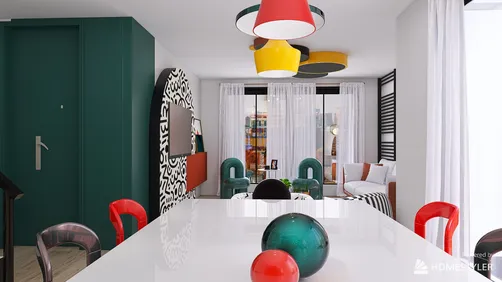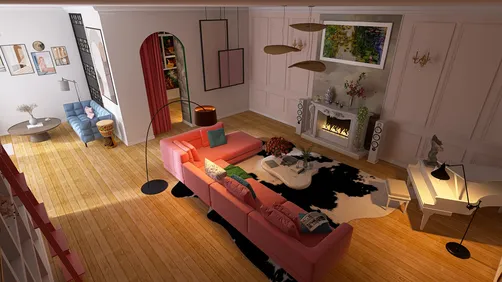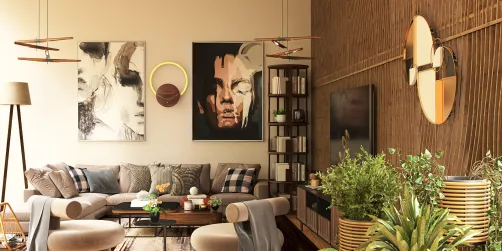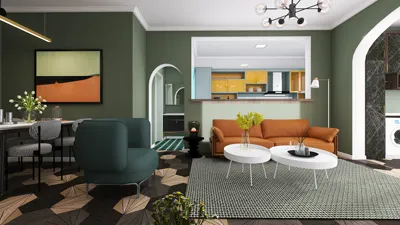
As the future approaches with each passing quarter, smaller teams continue to grapple with distractions, lapses in focus, and workplace clutter. Insights from Houzz indicate a growing trend in workspace enhancements focused on acoustics and layout, highlighting that individuals are increasingly feeling the pressure. I’m currently developing an office floor plan designed for four members, serving as a foundational template for our future work dynamics. This design aims to seamlessly integrate presence, privacy, and an agile workflow, reminiscent of a toolkit for spatial reasoning intertwined with daily routines, and tools like Homestyler can play a role in visualizing these dynamics.
Quad Grid with Shared Core
Design Concept: The setup features four dedicated workstations positioned at the corners, complemented by a communal core that houses a meeting pod and essential resources—addressing the need for both solitude and brief collaborative interactions in modern work environments.
Flow: The trajectory is straightforward—entering the space, utilizing a drop zone, proceeding to personal desks, engaging in the shared pod, accessing the resource wall, and finally exiting; this clean loop functions like an efficient algorithm.
Sightlines: Diagonal sightlines facilitate peripheral awareness while minimizing face-to-face distractions; the pod is visually subdued, akin to a subtle layer in user interface design.
Storage: Each desk is equipped with vertical storage modules, supplemented by a central archive cabinet; this arrangement allows for quick access while maintaining the necessary focus bandwidth.
Furniture Arrangement: Work surfaces should be between 48–60 inches paired with ergonomic seating; the pod caters to 2–3 individuals while millwork at a depth of 14 inches ensures a compact yet adaptable workspace.
Verdict: This configuration is scalable—by incorporating sensors for light and sound, it promises to maintain a serene and adaptable atmosphere over the next five years.
save pin
Linear Spine with Acoustic Pockets
Design Concept: The design features a central spine composed of a bench and cable management system, branching into four acoustic pockets to accommodate hybrid workflows that blend communication and concentrated work.
Flow: The sequence begins at the spine entry, allowing for the selection of pockets, followed by call booths, whiteboard access, and library shelving; this branching design resembles modular programming architecture.
Sightlines: Low partitions establish a hierarchy of visibility; focus zones are strategically placed to avoid direct glare, emphasizing primary tasks similar to how user interfaces prioritize functions.
Storage: Convenient under-bench drawers provide quick access to essential tools, while wall-mounted shelving serves as slower retrieval storage, yielding clear distinctions for fast and deep storage needs.
Furniture Arrangement: Bench depth is set at 30 inches; the pocket desks at 48 inches; acoustic panels should boast an NRC rating of 0.8 or more, ensuring optimal sound absorption alongside rigorous design standards.
Verdict: This linear arrangement ensures that micro-teams remain agile; the blend of quiet zones and easy access makes it well-suited for future demands in collaborative sprint scenarios.
save pin
Pinwheel Collaboration Hub
Design Concept: This design features four desks arranged around a central round table, creating a pinwheel effect that directs energy toward a focal hub, ideal for rapid decision-making and resource sharing.
Flow: The routine consists of entering from the perimeter, accessing personal workstations, gathering around the hub table, utilizing sideboard tools, and retreating to a quiet nook; this circular path minimizes context switching.
Sightlines: Gentle radial views foster a sense of peripheral connectivity; the hub serves as the primary meeting point while the surrounding edges provide secondary layers of interaction.
Storage: A 360-degree sideboard encircles the center for easy access to supplies; individual lockers provide personal storage, ensuring organization through predictable access points.
Furniture Arrangement: Includes a round table with a diameter of 48–54 inches, desks measuring 50 inches, adjustable swivel task chairs, and maintaining clearances of 36 inches for unobstructed movement.
Verdict: The pinwheel model encourages swift agreement; over five years, it adapts to a blend of in-person and remote dynamics while remaining comprehensible and supportive for all involved.
save pin
Final Takeaway
The design of an office floor plan for four members emphasizes more than just the physical area—it revolves around essential interfaces such as flow, communication latency, and collaborative intelligence. Configurations including a quad grid, linear spine, or pinwheel hub effectively materialize the future of work within practical layouts. From my perspective, the most effective small offices aren't necessarily expanding; rather, they are becoming more purposeful, resembling dynamic systems akin to living software. Tools like Homestyler facilitate this visualization process, bringing creative ideas to fruition.
Homestyler is an incredible online home design platform that makes redesigning spaces fun and accessible. With its user-friendly design tool, stunning 3D renderings, and a wealth of video tutorials, you can effortlessly create your dream home, no matter your experience level. Start designing today!






















![Design [4]](https://hs-designs.homestyler.com/production/design/images/07c2de3a-88ec-4be8-8910-ff255b795bc2/1731419398293/7841697.jpg?x-oss-process=image/resize,w_502,m_mfit/format,webp)