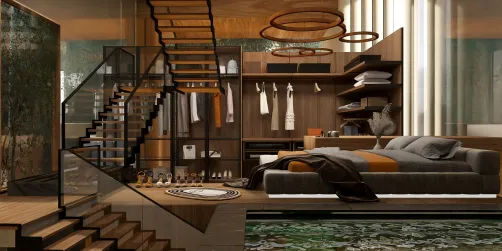
As we look towards the future, lifestyles are increasingly challenged by the congestion and navigation issues prevalent in today's shared buildings. Many of these structures still rely on single-stair designs, even as our lives require more fluid movement. According to insights from the NAHB, the trend in multi-family residences is towards more compact living spaces coupled with a rise in resident numbers, amplifying circulation conflicts. This is precisely where implementing a three-stair layout can serve as an effective solution. I consider this design as a strategy for optimizing daily flow, offering a structure that is equipped to handle the increasing density of urban living without adding to the chaos. Here, a spatial reasoning toolkit is not merely a tool, but rather a mindset essential for modern architecture.
Core Design with Dual Auxiliary Stairs
Design Consideration: The design features one primary stair that serves as the central artery, complemented by two auxiliary stairs that distribute the traffic load, ensuring resilience for the evolving live-work dynamics of the future.
Flow Dynamics: The pathway begins at the main entry, utilizes the central stair for public movement, while the auxiliary stairs provide quieter access to individual units. Emergency routes are designed to replicate this flow for added safety.
Visibility and Sightlines: The line of sight from the lobby toward the central spine is kept clear, while the auxiliary routes remain partially obscured, prioritizing ease of navigation for guests and a tranquil environment for residents.
Storage Solutions: The lobby and landing niches serve as storage nodes, featuring parcel lockers, stroller bays, and collapsible bike racks—strategically arranged based on proximity and usage frequency.
Furniture Integration: The corridors maintain an API width of 5' to 6', and stair landings accommodate 36" turning radii. Unit doors are staggered to reduce the potential for collisions with everyday belongings.
Conclusion: This layout effectively represents a strategy for managing future capacity—featuring a stable central channel alongside flexible pathways that can comfortably accommodate growth over the next five years, all while eliminating spatial stress.
save pin
Triangular Distribution Core
Design Framework: Three stairs are strategically placed at the vertices of a triangle, evenly distributing egress loads and decentralizing movement patterns for mixed-use environments.
Flow Mechanics: Retail and service areas are aligned with the nearest stair; residents naturally opt for the shortest route, while maintenance crews utilize the third stair to avoid disruptions—akin to parallel processing.
Visual Orientation: Each stair provides a clear visual landmark, framed by light wells and layered signage, helping to decrease decision fatigue.
Storage Alternatives: Corner alcoves are transformed into storage hubs, featuring vertical mail slots, shared tools, and seasonal bins, with fire-rated cupboards that seamlessly integrate into the structural design.
Furniture Compatibility: The triangular core allows for longer unit walls, facilitating modular furniture arrangements such as 9' sofas, adjustable desks, and Murphy beds, with API clearances kept consistent throughout.
Conclusion: This triangular layout functions as an effective system of instructions—offering equal paths, minimizing bottlenecks, and providing a community atmosphere that adapts to changing multi-family needs.
save pin
Circulatory Loop with Three Access Points
Design Strategy: A circular corridor connects the entire floor plan, featuring three stair nodes that serve as essential checkpoints—particularly beneficial for co-living setups and micro-units where every small decision counts.
Flow Perspective: Residents can select the nearest stair node; service and cleaning crews typically operate in a clockwise manner, while emergencies turn the loop into directed exits, showcasing the versatility of the layout.
Visibility: Extended sightlines along the corridor are enhanced by framed thresholds at each node, transforming the area into a visually intuitive interface illuminated by light gradients.
Storage Features: Each node hosts slim lockers, while linen closets are integrated into the mid-loop sections, and shared utility spaces at corners ensure expanded storage capabilities without clutter.
Furniture Configuration: Units branching off from the loop adhere to predictable API widths: a minimum of 32" doorways, 48" landings, and 24" depth for modular wardrobes for seamless flow.
Conclusion: This loop functions like an operating system, facilitating smooth daily tasks and providing decisive navigation during emergencies, all while preparing for five years of high-density, multi-use living environments.
save pin
## Final Thoughts
The innovative three-stair building floor plan prioritizes intentional movement over mere redundancy, creating interfaces that enhance the interactions of movement, storage, and sightlines. In the context of multi-family architecture, the tri-core circulation system approaches density like a data management strategy—structured, clear, and humane. The thoughtful choice of three access points redefines how residents engage with both micro-units and larger apartments. Based on my experience, the most effective buildings are not simply larger; they are more deliberate in their design, and I am committed to crafting spaces that operate like peaceful, high-capacity systems in the modern world, leveraging tools like Homestyler for enhanced design accuracy and experience.

Homestyler is your go-to platform for effortless home design. With its user-friendly online design tool, stunning 3D renderings, and a wealth of DIY video tutorials, you’ll easily transform your vision into reality. Start creating your dream space today!