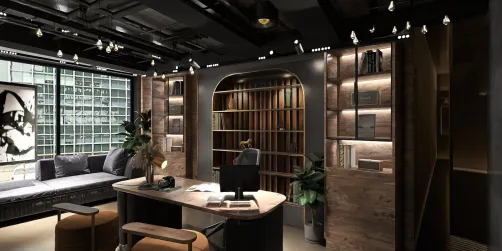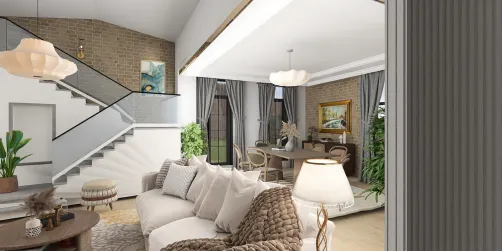
The upcoming work lifestyle will revolve around modular and mobile designs that prioritize data intelligence. While today's offices face challenges such as wayfinding issues, noise disturbances, and rigid layouts, a new era is on the horizon, and I am actively designing for it with a spatial reasoning toolkit. Reports from AIA reveal that firms are shifting towards adaptable interiors and health-focused metrics within their commercial spaces. My clients are requesting modern commercial floor plans that function like software—scalable, understandable, and responsive, akin to what you can achieve in Homestyler.
Grid A: 12x12 Structural Rhythm Featuring a Central Collaboration Spine
Design Logic: The 12x12 column grid balances leasing flexibility with mechanical routing, anticipating tenant transitions and hybrid work dynamics.
Flow: The layout progresses from entry → reception area → central collaboration spine → communal neighborhoods → quiet zones, reflecting a seamless transition from public to private spaces.
Sightlines: Extended longitudinal views along the spine and cross-views every third bay create a hierarchy of information through varying light gradients.
Storage: Similar to a server cache, there are shallow wall bays spaced every 24 feet, mobile archives positioned near cores, and high-density units situated within blind spots.
Furniture Fit: Workstations configured in 6-foot modules, touchdown bars extending 12 feet, and relaxed areas arranged in 18-foot clusters—ensuring clean integration with the grid.
Verdict: This design fosters efficient operations over a five-year period of fluctuating occupancy, maintaining team dynamics and culture without interruption.
save pinOpen in 3D Planner Processing...
Grid B: 9x18 Rectilinear Mesh Accompanied by a Perimeter Wellness Loop
Design Logic: The 9x18 grid design is optimized for capturing natural light and efficiently organizing programs, with future health regulations focusing on perimeter loops that promote movement and offer micro-retreats.
Flow: The layout circulates as a ring buffer: lobby → wellness loop → team pods → resource bases → focus rooms, with repeatable patterns that can be scaled up or down.
Sightlines: Offering a panoramic view along the perimeter and interior highlights every 9 feet, this layout emulates a user interface with depth transitioning from bright edges to muted cores.
Storage: Deposited across the space, there are 9-foot niche lockers, 18-foot equipment storage walls, and concealed AV racks situated at grid junctions.
Furniture Fit: Tables designed in 9-foot increments, adjustable screens resonating with an 18-foot rhythm, and lounge areas at every 27-foot node—all designed with future-proof standards in mind.
Verdict: This configuration yields a stable signal-to-noise ratio, allowing teams to enhance their work dynamics without the need for constant restructuring each quarter.
save pinOpen in 3D Planner Processing...
Grid C: 15x30 Hybrid Grid with an Innovative Diagonal Corridor
Design Logic: The 15x30 grid accommodates heavy-duty programs like labs and innovative spaces, while a diagonal corridor minimizes latency between departments, preparing for agile cross-domain collaborations.
Flow: Entry → diagonal corridor → prototyping areas → meeting clusters → quiet zones; creating fast pathways for creativity and slower paths for concentrated work.
Sightlines: The diagonal design unveils various scenes; nodes serve as inviting UI buttons with clear visibility and varying brightness levels.
Storage: Extended storage at 30-foot bays for equipment and mini-storages at 15-foot intervals for daily necessities, organized and labeled akin to software repositories.
Furniture Fit: Solid benches spaced on 30-foot intervals, mobile carts on 15-foot centers, and soft seating located at angles in the corridor—blending precision with flexibility.
Verdict: Over the next five years, this grid structure will facilitate growth and specialization without jeopardizing its foundational design elements.
save pinOpen in 3D Planner Processing...
Final Takeaway
In modern designs, commercial building floor plans using grids resemble programmable interfaces for effective work environments. Variations such as structural meshes, perimeter loops, and diagonal corridors serve as fundamental strategies for adaptability and well-being. The most intelligent commercial spaces won’t necessarily be larger but will be more intentional with their grid configurations; from my experience, even minor spatial decisions can significantly influence how teams navigate, concentrate, and interact.
Discover your dream space with Homestyler! This user-friendly online home design platform offers a powerful design tool, stunning 3D renderings, diverse design projects, and helpful DIY video tutorials. Bring your interior ideas to life effortlessly and inspire your creativity today!