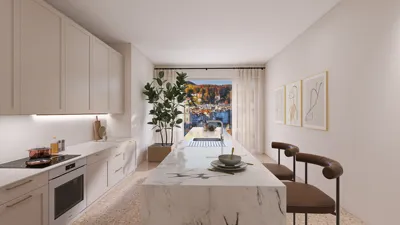
With the increasing demand for seamless arrivals, the current infrastructure often causes delays and distractions for those arriving at buildings. AIA surveys reveal that operational efficiency ranks as a primary concern for clients, which is definitively noticeable at the ground level. In my 2D parking layout, I envision the entry as a protocol handshake leading into a home environment. The future influences design today, and I'm dedicated to creating spaces that meet these evolving needs, incorporating tools like Homestyler for optimal designs.
spatial reasoning toolkit
Looped Entry Spine with Clear Bays
Design Logic: The implementation of a one-way loop minimizes conflicts, prepares for electric vehicle growth, and harmonizes with urban micro-mobility hubs. This structure emphasizes predictable maneuvers rather than simply maximizing capacity.
Flow: The sequence includes gate entry, a slow zone, bay selection, parking, and exit to the lobby; it's akin to a well-organized command line minimizing unnecessary branches.
Sightlines: Low columns, mirrored corners, and bands of light provide tiered visibility, allowing drivers to see the parking bays first, followed by pedestrians, and finally the exits.
Storage: Wall-mounted racks, specific tire niches, and dedicated charging cabinets serve as localized caches, ensuring tools are kept handy while maintaining high throughput.
Furniture Fit: Bay widths set at 9 ft, with EV chargers positioned 36 in off-center, and strollers accommodated near lifts—these specifications relate effectively to real-world vehicles and lifestyles.
Verdict: This strategically designed loop operates smoothly; in five years, its rhythm remains intact as electric vehicles, cargo bikes, and deliveries become part of an intricate choreography.
save pin
Split-Grid with Pedestrian Safe Corridor
Design Logic: Two adjacent parking grids are positioned around a protected walkway, ensuring that mixed traffic—including couriers, children, and mobility aids—shares the ground space safely.
Flow: The system proceeds from entry to left/right branching for parking, converging into a central corridor, then leading to the lobby and mail areas; streamlined paths decrease collision risks.
Sightlines: The central corridor features glazing that acts like a user interface header; reflective paint and beacon nodes indicate speed and crossing points in multiple layers.
Storage: Parcel lockers and collapsible cart bays are strategically placed to manage delivery surges, acting as effective buffers close to the lobby.
Furniture Fit: Compact car bays are 8.5 ft wide, while ADA-compliant spots are 11 ft with designated side load zones; benches serve as navigational anchors.
Verdict: The split-grid structure appears resilient to shifts in delivery demand and family activity, maintaining a seamless operation throughout.
save pin
Micro-Mobility Dock with EV Spine
Design Logic: A central electric vehicle spine separates car bays from bicycle and scooter docks, anticipating charging needs as an essential utility infrastructure.
Flow: The process is quick—in through the entrance, aligning with the spine, parking, charging or docking, and then accessing the lift; this outlined sequence is straightforward and repeatable.
Sightlines: An LED ribbon intelligently directs users along the spine; docking signs and floor markers create a multi-layered heads-up display for quick understanding.
Storage: Secure helmet drawers, shelving for panniers, and organized cable management ensure tidiness, thereby enhancing operational speed during peak times.
Furniture Fit: Bike docks measure 24 in between centers, scooter rails are spaced 18 in apart, while EV stalls facilitate rear access—thoughtful yet efficient configurations.
Verdict: As fleets transition to electric, this layout functions like an intuitive, plug-and-play interface while accommodating pedestrian needs and arrival rituals.
save pin
Final Takeaway
A ground floor parking layout extends beyond mere stalls; it serves as the initial contact point for an urban lifestyle that is rapidly evolving. Configurations like the split-grid and electric vehicle spine are designed to embrace micro-mobility and delivery dynamics without excessive spatial requirements. The most effective designs I create integrate circulation, sightlines, and storage as if they were code—compiled for clarity rather than complexity. From my perspective, the future greatly favors precision at each entry point, helped by innovative solutions such as Homestyler.


Homestyler is your go-to online home design platform, offering a user-friendly design tool that allows you to create stunning spaces effortlessly. With impressive 3D renderings, a wealth of design projects, and helpful DIY video tutorials, turning your home design visions into reality has never been easier!