As we look towards the future, there's an increasing need for seamless bandwidth within our homes, especially as many current north-facing residences struggle with challenges like heat control, excessive glare, and an unstructured flow of movement. The integration of a spatial reasoning toolkit is essential in refining this flow. Insights from AIA surveys reveal that homeowners prioritize the quality of daylight as one of their top remodeling goals, making a north-facing ground floor plan an excellent testing ground for achieving the perfect balance of brightness, privacy, and climate through a cohesive design approach.
Courtyard Spine + Split Public Core
Design Logic: The inclusion of a central courtyard serves as both a thermal barrier and a light distributor, effectively differentiating living and dining spaces while fortifying the northern facade.
Flow: The journey begins at the entry, leading through the gallery hall into the living area (to the west), followed by the dining room (to the east), then pivoting to the courtyard, leading to the southern kitchen and finally, a guest suite near the front.
Sightlines: The design creates layered views, flowing from the foyer to the courtyard and treetops; the dining area maintains a shallow angle toward the street, while the kitchen provides a view of the courtyard, acting as a central feature.
Storage: Built-in perimeter units are installed along the gallery; a deep pantry conveniently located next to the kitchen; bench storage is installed beneath the courtyard windows.
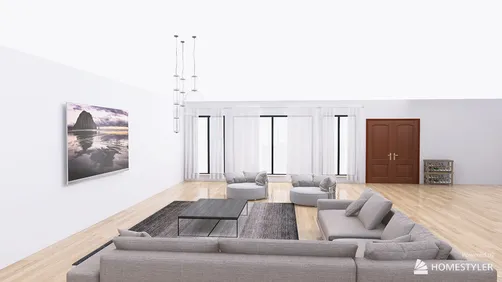
Furniture Fit: Sofas are aligned in a way that resembles clean APIs fitting into 10–12 ft bays; the dining table comfortably accommodates 8–10 seats within a 12x15 area; courtyard seating is designed to be modular at a 900–1100 mm grid size.
Verdict: This arrangement consolidates daylight and privacy into a single cohesive element; within five years, it will stand as a resilient and energy-efficient environment, enhancing social interactions.
save pin
Offset Stair + Flexible Studio Bay
Design Logic: By positioning the stair slightly off-center, a studio bay emerges next to the north facade, serving as a versatile space that could function as a family room or a guest lounge.
Flow: The sequence begins at the entry, leading into the studio bay, followed by a pocket door to the living area, a stair node, then looping around the kitchen and dining space, with a convenient powder room nearby.
Sightlines: The studio maintains controlled glare with high-level glazing to the north; the living area perceives the stair as a vertical feature, while the kitchen provides a framed view towards the garden.
Storage: Under-stair drawers serve as quick-access storage; the studio is equipped with wall systems for organizing gear; a dining credenza helps manage table clutter as a functional buffer.
Furniture Fit: The studio can accommodate a desk measuring 1800 mm with an additional perch; in the living area, a 2.4–2.7 m sofa fits nicely against a 3.6 m wall, with the stair landing designed for a slim console table.
Verdict: The offset stair transforms into a central hub, enabling a dynamic switch between work and relaxation, which is anticipated to be a staple in future homes, demonstrating everyday elasticity.
save pin
South Utility Bar + Thermal Zoning
Design Logic: A continuous utility bar along the southern side—incorporating laundry, mudroom, powder room, and storage—creates thermal zoning and enhances the calmness and brightness of the north facade.
Flow: Transition from the carport into the mudroom, leading to the laundry/powder area, followed by the kitchen, dining room, and courtyard, before reaching the living space; service pathways run parallel to public routes, resembling intertwined threads.
Sightlines: The utility bar features well-placed high clerestory windows, while the living and dining areas enjoy expansive low-glare views towards the northern garden; the courtyard functions like a user interface for the home.
Storage: Tall units within the utility bar serve as primary storage; the kitchen pantry is strategically located at the junction; mudroom cubbies provide rapid-access solutions for daily needs.
Furniture Fit: The dining setup includes a table measuring 900x2400 mm; the kitchen island spans 900x2100 mm while ensuring clear circulation of 1000 mm; the living area features a rug of 2400x3400 mm that anchors the seating arrangement.
Verdict: By keeping service zones separate from social areas, this plan remains stable throughout seasonal changes—in five years, it will still feel finely tuned rather than worn out.
save pin
Final Takeaway
An optimal design for a north-facing home's ground floor in a 10 marla configuration is achieved when factors like daylight access, program flow, and thermal zoning converge into a unified layout. Terms such as 'north-facing configuration,' 'courtyard design,' and 'thermal buffer areas' help maintain clarity in 2D planning while anticipating a mixed-use lifestyle. My perspective suggests that the most advanced homes of the future won’t necessarily be more extensive—they will be more thoughtfully designed, and tools like Homestyler can significantly assist in visualizing these concepts.



Discover the ease of home design with Homestyler! This intuitive online platform offers a seamless design tool, stunning 3D renderings, a variety of design projects, and helpful DIY video tutorials. Transform your living space effortlessly, regardless of your experience level!



















![Design [4]](https://hs-designs.homestyler.com/production/design/images/07c2de3a-88ec-4be8-8910-ff255b795bc2/1731419398293/7841697.jpg?x-oss-process=image/resize,w_502,m_mfit/format,webp)