Bathroom Design Scene
The 'Bathroom Design Scene' refers to a versatile, style-agnostic interior space planning challenge centered on functional elegance, sensory comfort, and aesthetic cohesion — regardless of scale (compact or spacious) or stylistic direction (e.g., Modern Farmhouse, Eclectic, Scandinavian, or Transitional). It emphasizes human-centered spatial flow, material harmony, lighting layering, and intentional zoning for hygiene, relaxation, and daily ritual. This scene is not defined by square footage alone but by how well design decisions serve wellness, accessibility, and visual serenity — making it a critical benchmark for interior space planning in residential projects.
Design Challenges & Common Pitfalls
Common challenges in bathroom design include balancing limited floor area with full functionality (toilet, shower/tub, vanity, storage), managing moisture and ventilation without compromising aesthetics, integrating sufficient natural and artificial light in window-constrained layouts, achieving visual warmth in inherently utilitarian spaces, and maintaining cohesive material palettes across wet and dry zones. Poor spatial hierarchy — such as placing the toilet in direct line-of-sight from the door or overcrowding fixtures — remains a frequent error that undermines privacy and usability. These issues directly impact indoor air quality, long-term maintenance, and user experience — highlighting why thoughtful interior space planning is non-negotiable.
✅ Prioritize Functional Zoning & Circulation Flow
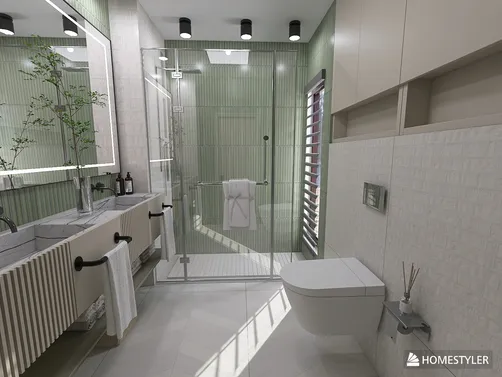
A well-zoned bathroom separates wet (shower/tub), dry (vanity/mirror), and private (toilet) areas with clear circulation paths — ideally allowing 60–75 cm of clearance around each fixture and avoiding fixture overlap. Strategic placement of doors, mirrors, and lighting enhances perceived spaciousness and supports intuitive movement. Homestyler AI design tools enable rapid iteration of layout options using drag-and-drop fixtures and real-time spatial measurements, helping designers validate ADA-compliant clearances and optimize traffic flow before finalizing.

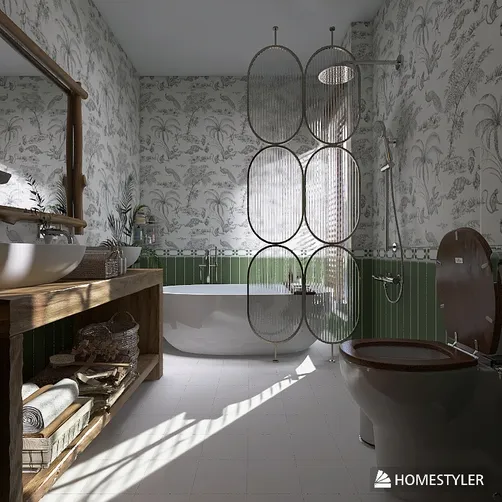
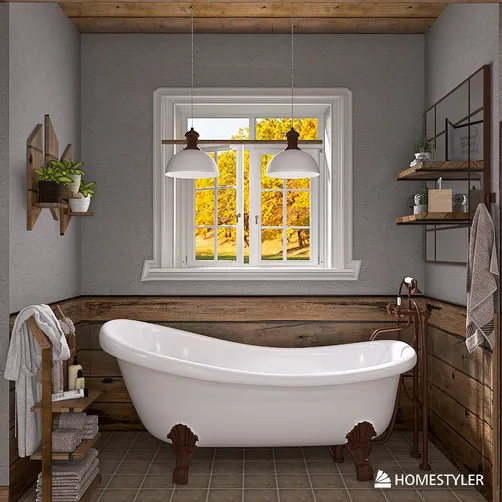
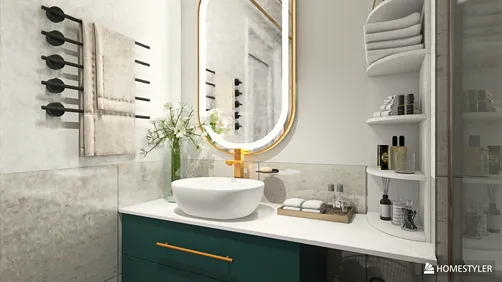
Isa Martinez’s 'Detalles de Diseño: Un Refugio Cálido' masterfully applies functional zoning by positioning the freestanding bathtub away from the entry sightline, using a curved vanity to define the dry zone, and placing wall-mounted fixtures to preserve floor continuity. Using Homestyler AI design tools, she simulated natural light penetration (g_tropical_beach HDR) and adjusted wall lamp placement to eliminate shadows near the mirror — demonstrating how AI-powered interior space planning refines both ergonomics and ambiance.
Start Free Design Now🎨 Curate Texture, Material & Color Harmony
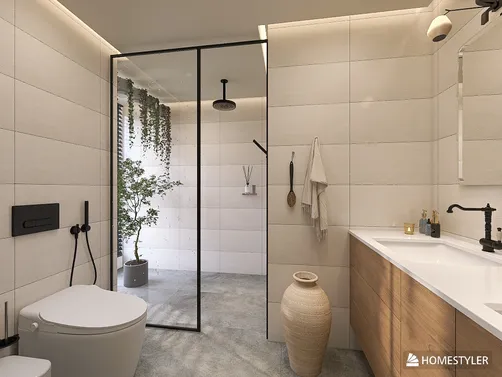
Texture contrast (e.g., smooth tile vs. reclaimed wood), material continuity (stone floors extending into shower bases), and restrained color palettes (3–4 dominant hues with tonal variation) unify the bathroom visually and tactilely. Warm neutrals, organic matte finishes, and strategic accent materials (brass, matte black, or aged copper) reinforce style identity while improving durability and ease of cleaning. Homestyler’s material library and one-click style transfer features allow instant testing of finishes across walls, floors, and vanities — accelerating texture-based decision-making without physical samples.

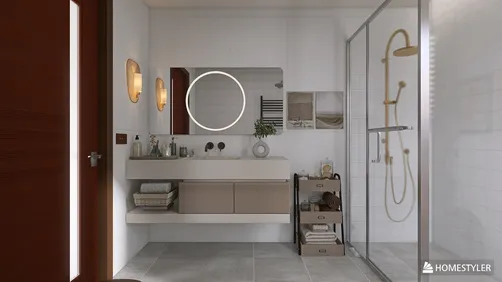
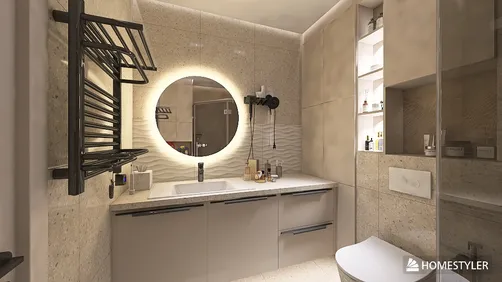
Annie Audette’s 'MODERN BATHROOM CHALLENGE' leverages Homestyler AI design tools to harmonize high-gloss black cabinetry with veined white marble countertops and textured concrete-look wall panels — all under warm evening lighting (c_peoples_square HDR). Her use of consistent undertones (cool grays + soft whites) and reflective surfaces creates visual expansion in a compact apartment bathroom, proving how AI-assisted material curation elevates perceived luxury and coherence in interior space planning.
Begin Your Luxury Bathroom💡 Layer Natural & Artificial Lighting Strategically
Effective bathroom lighting combines ambient (ceiling or recessed), task (mirror-integrated or wall sconces at eye level), and accent (niches, toe-kick, or shower recess lighting). Daylight simulation is critical: windows should face north or east for consistent, glare-free illumination; skylights require UV-filtering glazing. Homestyler’s dynamic sunlight slider and HDR environment presets (e.g., d_ljz_day, g_tropical_beach) let designers preview real-world luminance distribution, shadow depth, and color rendering — enabling precise fixture placement aligned with circadian wellness principles.

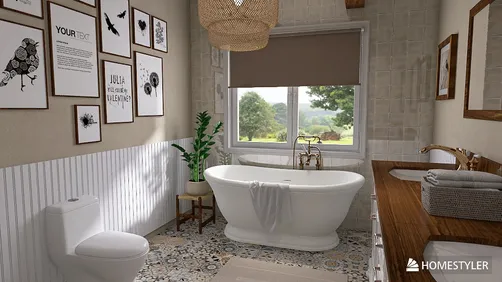
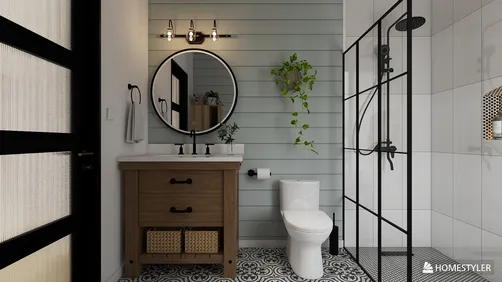
IMD Interiors’ 'Modern Farmhouse Bathroom Design' uses Homestyler AI design tools to simulate daylight (d_ljz_day HDR) and position dual wall lamps flanking the mirror — eliminating facial shadows while reflecting shiplap texture and greenery. The design also integrates recessed LED strips under floating vanities and within shower niches, showcasing how layered lighting transforms utility into ambiance. This exemplifies advanced interior space planning where light isn’t an afterthought — it’s structural.
FAQ
Q: Do I need prior design experience to join the Weekly Room for Web competition?
Not at all. Homestyler’s intuitive interface and AI-powered suggestions (e.g., auto-layout, material pairing, lighting simulation) make professional-grade interior space planning accessible to beginners. Tutorials and template-guided workflows help users rapidly translate inspiration into polished designs.
Q: Can I submit designs using only one of the two templates (Modern Farmhouse or Eclectic)?
Yes — submissions must use *either* the Modern Farmhouse-style Bathroom *or* the Eclectic-style Bathroom empty room template (found in the Web Asset Market > Project Templates). Mixing templates or using custom base models disqualifies entries.
Q: How does Homestyler AI assist with realistic lighting and material rendering in bathroom scenes?
Homestyler AI uses physics-based HDR environments (e.g., g_tropical_beach, peoples_square) and real-time sunlight sliders to preview how natural light interacts with tiles, mirrors, and textures. Its material engine renders accurate reflectivity, grain, and sheen — crucial for evaluating moisture-resistant finishes and achieving photorealistic interior space planning outcomes.
Q: Are there restrictions on fixture brands or model counts per design?
Yes — the contest enforces a tool limit of 4 (as noted in 'toolLimits':[4]). This encourages focused, high-impact Homestyler design techniques: prioritize key statement pieces (e.g., sculptural faucet, freestanding tub), use smart grouping, and rely on AI-generated variations rather than cluttering with excessive assets.


Homestyler offers an easy-to-use online home design tool with stunning 3D renderings, inspiring design projects, and helpful DIY video tutorials. It’s perfect for bringing your interior design ideas to life, whether you’re a beginner or a seasoned decorator.
Дизайн сейчас бесплатно