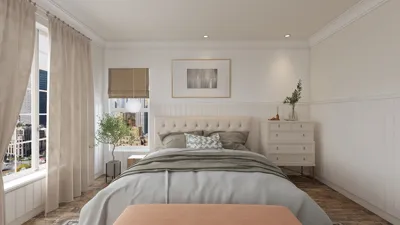


High-resolution STL building models should embody the precision of construction details while also capturing the creativity of concept sketches. My method merges architectural discipline with the practicality required for 3D printing, emphasizing clean topology, watertight structures, and the deliberate articulation of façades, massing, and structural elements. This ensures that the model not only prints successfully but also conveys design intentions effectively, thanks in part to tools like Homestyler.
Performance considerations backed by evidence
STLs intended for printing are significantly enhanced when approached from a space planner's perspective. The visual hierarchy and clarity play a crucial role in how models are interpreted by stakeholders. Color, often underestimated in visualization, influences perception; warm colors draw the eye closer, while cool hues recede. This concept is reflected in design psychology findings by VerywellMind on color strategy. For workplace massing studies, clarity in circulation leads to improved decision-making; studies show a correlation between layout understanding and productivity, supported by research from Herman Miller regarding movement and task facilitation.
Intent and printing logic in design
When creating a premium STL, I consider structural realism alongside printing limitations: maintaining a minimum wall thickness (≥1.0–1.2 mm for typical FDM nozzles), employing chamfered edges to mitigate stress points, and consolidating components to prevent fragile overhangs. Ergonomically, a handheld model needs to balance weight and tactile sensation; reinforcing building cores and atria without adding clutter is key. For lighting demonstrations, massing surfaces are adjusted to capture light at angles between 30–60°, complementing the contrast guidelines from IES luminance and glare control research. If the STL will serve WELL-oriented narratives—such as daylight access and biophilic design—I size windows to align with storytelling principles aligned with the WELL v2 framework's categories, including Light and Mind.
Standards for modeling that I adhere to
- Geometry must be watertight and manifold: no non-manifold edges or flipped normals are allowed.
- Organization should feature single-shell or logically multi-shell structures: façade, podium, roof, landscape base plate.
- Scaling must be aware of printing capabilities: common scales include 1:500 for skyline massing and 1:200–1:100 for facades, with appropriate tolerances maintained.
- Overhang management: self-supporting angles should not exceed 45°, with integrated ribs placed under lengthy canopies.
- Texturing should be achieved through relief: replace minute details with discernible macro-patterns (relief depth of 2-3 mm) that can withstand post-processing.
- Orientation markers: subtle datum and edge cues to assist in presentation.
Spatial relationships and visual flow
Even massing STLs can benefit from compositional principles: a 60/30/10 mass distribution (for primary, secondary, and accent volumes), consistency in façade bays for rhythm, and roofline breaks that draw the viewer's eye. I modify the proportions between plinth and tower to maintain model stability on the print bed and to ensure a visual anchor. In models depicting workplace layouts, the cores and circulation paths are simplified into a clearer loop, mirroring behavioral trends identified in Gensler Research concerning movement and collaboration spaces.
Materials, light, and glare considerations
For demonstration, I frequently recommend a neutral matte filament that diminishes specular glare and highlights shadows effectively. When the STL is displayed under directional lighting, depth adjustments are made to ensure visibility of contrasts at lighting levels typical for display environments (300–500 lux), resonating with IES guidance on ambient lighting standards. For clients requiring color prints, I apply color psychology principles—using warm shades to emphasize entry spaces and subtler tones for service areas to keep the focus on public interfaces.
Process from CAD to STL
- Initiate with clean BIM/CAD files (from tools like Revit, Rhino, or SketchUp) before reworking for solid outputs.
- Minimize Boolean operations; I prefer constructive geometries to evade thin artifacts.
- Conduct mesh analyses (checking for holes, intersections, and flipped normals) prior to exporting.
- Export with an angular tolerance that retains curves while avoiding excessive file size, typically maintaining a chord height of 0.05–0.15 mm for mid-scale prints.
- Perform slice tests at both draft and fine settings to verify support behavior and estimate printing time accurately.
- If the model illustrates interior layouts, I provide a simplified version of the floor plate. For layout testing, I can share a link to an interior layout tool for rapid scheme revisions.
Recommendations for print setup
- Nozzle size: generally, 0.4 mm for detailed outputs, 0.6 mm for larger massing structures.
- Layer height: varies from 0.12 to 0.2 mm, based on the fidelity needed for curves.
- Infill ratio: between 15-25% gyroid for stability without adding weight.
- Bed adhesion: a brim for taller, slender towers; rafts should only be used when the base is minimized.
- Supports: use custom tree supports for cantilevers, which can be removed with minimal scarring.
- Post-processing: involves light sanding, using XTC-3D or primer for smoother façades, and employing paint highlights to distinguish various program volumes.
Common use cases I deliver
- Conceptual massing models intended for client presentations.
- Detailed façade blocks to assess shadow effects and articulation.
- Comprehensive models of campus or multi-building setups that reflect hierarchical readings.
- Urban context representations to facilitate skyline discussions.
- Mock-ups of workplace floor plans to narrate circulation and collaboration zones.
- Promotional models for marketing brochures and exhibition displays.
Contents of files and compatibility notes
Every premium package includes: an optimized STL, the original editable geometry available on request, named parts suitable for multi-material prints, orientation guidelines, slicing profiles, and a report on printability (covering overhangs, wall thickness, and estimated print times). The STL is confirmed to function across standard slicers like PrusaSlicer, Cura, and IdeaMaker, ensuring compatibility with both FDM and resin technologies.
Sustainability and durability considerations
When clients advocate for sustainable options, I recommend using recycled PLA or PETG and design models with minimal support structures to reduce material waste. Integrated structural ribs enhance durability for models that will be handled during events. For shipping, I opt for modular components utilizing dowel or magnet connections to preserve structural integrity without visible seams.
Guidelines for commissioning
Please provide the scale, desired level of detail, intended lighting configuration, and whether to imply or state interior logic explicitly. Share any available CAD files or a clear brief on massing requirements. I will present a draft mesh for evaluation, followed by a refined print-ready STL containing notes and optional colorway suggestions.
Frequently asked questions
A scale between 1:500 and 1:200 is optimal for massing and skyline contexts. For showcasing façade details and entries, a scale of 1:100 or larger is preferred.
I conduct manifold checks, remove self-intersections, align normals, and ensure accuracy through slice previews. Overhangs are designed to be 45° or less, or structurally reinforced.
Absolutely. Circulation pathways, collaboration nodes, and core elements are simplified for clarity, reflecting findings from Herman Miller regarding movement and task support.
Under lighting conditions of 300–500 lux, relief depths and angles are adjusted to maximize shadow visibility while controlling glare, in alignment with IES principles.
Yes, elements like façades, bases, and accents can be separated into distinct shells, accommodating multi-material or resin printing workflows.
I recommend PETG for improved impact resistance, PLA for clean edges, and ABS or ASA for outdoor displays. Structural ribs assist in maintaining rigidity, particularly in slender designs.
Available upon request. For initial evaluations, I suggest creating simplified plates and core markers. For layout testing, I provide a link to an interior layout planner to facilitate quick iterations of circulation and zoning.
Warm accents can emphasize approach and public areas, while cooler tones allow for service volumes to recede. This approach aligns with the perceptual tendencies discussed in color psychology literature.
Conceptual massing STLs typically take 3 to 5 business days. Detailed façade studies may require 7 to 10 days, depending on the project's scope and the availability of references.
The time frame is contingent on the build volume of the printer. For oversized designs, I create split joints and dowels to allow for seamless assembly post-print.
Yes, I can adjust tolerances and surface detail to harness the resolution of resin printing while avoiding delicate micro-features.
Included are draft and fine profiles with recommended support structures and orientation tips tailored to widely used slicers.
Homestyler is your go-to online home design platform! With its user-friendly design tool, stunning 3D renderings, and a wealth of DIY video tutorials, transforming your space has never been easier. Explore endless design possibilities and bring your vision to life effortlessly!
Дизайн сейчас бесплатно
































