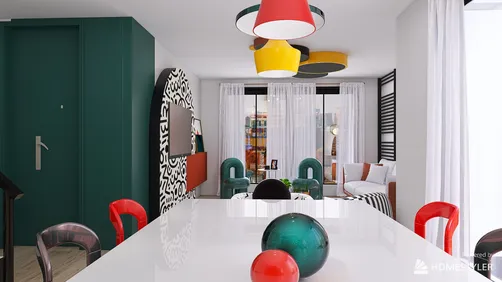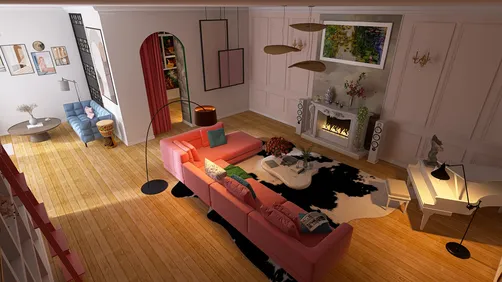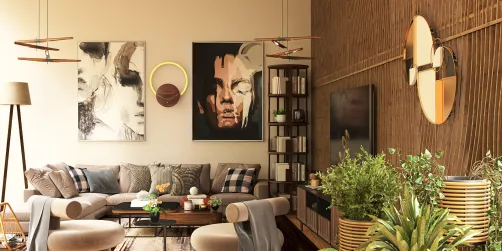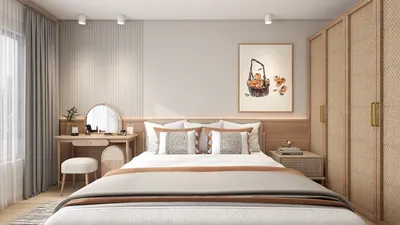
As the future approaches, the dynamics of multigenerational lifestyles, hybrid work environments, and ritual-filled weekends intersect with the limitations of today's crowded spaces and improvised storage solutions. According to trend observations from organizations like AIA and NAHB, there is a growing demand for versatile rooms and improved acoustics, aligning with Zillow's insights on the preference for adaptable home layouts. This perspective prompts me to examine the three-bedroom Indian house floor plans as early indicators of new domestic practices—where circulation, privacy, and festive interactions merge within a single structure. Using a spatial reasoning toolkit, I envision how families might thrive five years down the line with the aid of innovative design tools like Homestyler.
L-shaped Courtyard Spine
Design Logic: An L-shaped configuration encircles a compact courtyard, promoting natural light, cross-ventilation, and providing a ritual-ready central area that accommodates the needs of evolving multigenerational households.
Flow: The layout progresses as follows: Entry → foyer-mandala hub → living-dining area → courtyard pivot → bedrooms positioned on the quieter side; this sequence offers clear guidance with designated spaces for prayer and work.
Sightlines: Diagonal perspectives stretch from the foyer to the green void, layered similarly to user interface panels—public areas in the foreground, semi-private zones in the middle, and private spaces at the end.
Storage: Wall bays on the periphery serve as storage caches; seasonal sarees, pooja sets, and guest linens can be organized in labeled deep drawers situated near the courtyard's edge.
Furniture Fit: A dining clearance of 900–1050 mm, a sofa span of 1800 mm, and a pooja niche measuring 600 mm deep create design parameters that prevent spatial conflicts during festive events.
Verdict: This setup creates a breathable core that centralizes rituals while ensuring adaptability for peaceful study areas and transitions for aging family members.
save pin
Dual-Aspect Linear Rail
Design Logic: A linear layout featuring dual-aspect living spaces treats the home as a bandwidth manager—light flows through both ends, helping to stabilize daily peaks of activity from work, school, and guests.
Flow: The design follows this predictable pattern: Entry → drop zone → living rail → dining node → kitchen → bedroom cluster; it operates seamlessly, like a well-compiled pipeline that minimizes errors.
Sightlines: The long axial view captures attention; sliding screens adjust privacy levels, ensuring noise does not disrupt study time.
Storage: Tall wardrobes offer vertical storage solutions; a concealed utility track accommodates bulk items like grains and festival decorations, utilizing first-in, first-out organization.
Furniture Fit: With a modular sofa measuring 2400 mm, an extendable dining table for 4–8 guests, and study desks at a 1200 mm height—design tolerances cater specifically to hybrid working practices.
Verdict: This design is perfect for row plots and urban settings; the linear rail operates like a well-regulated bus, providing a serene experience even during peak festival days.
save pin
Split-Core with Sacred Niche
Design Logic: The layout's core divides movement around a compact pooja/study area, allowing family spaces to interact freely—prepared for the demands of remote work and the needs of older family members.
Flow: The organization is as follows: Entry → vestibule airlock → living area to the left, kitchen-dining to the right, bedrooms located behind the core; these detours are intentional, akin to subroutine calls to the central hub.
Sightlines: Short, framed views from clerestories provide guidance for light exposure while preserving modesty—layers that suggest rather than reveal.
Storage: Radial storage designs feature a near-kitchen everyday cache, occasional storage around the hub, and a deeper archive in rear bedrooms to balance accessibility with storage needs.
Furniture Fit: The queen beds are set at 1525 mm with 750 mm side clearance, a corner settee of 1800 mm, and a floor seating module for aarti—dimensions that serve as functional elements in the living space.
Verdict: This layout acts as a quiet, focused environment that accommodates change—whether kids become creators or parents take on caregiving, the design remains adaptable over time.
save pin
Final Takeaway
Three-bedroom designs in India have evolved from mere living spaces to dynamic operating systems. The most effective layouts for three-bedroom Indian houses view circulation as logic, storage as functional caches, and furniture as adaptable pieces supporting hybrid work, caregiving, and festive activities. My experience indicates that the smartest three-bedroom Indian house floor plans don't necessarily need to be larger—they just need to be more purposeful. With tools like Homestyler, I continue designing these spaces as future interfaces we can interact with today.
Homestyler is your go-to online platform for effortless home design. With its easy-to-use design tool, stunning 3D rendering options, and a vast collection of design projects and DIY video tutorials, you can transform your vision into reality in no time. Get creative today!



















![Design [4]](https://hs-designs.homestyler.com/production/design/images/07c2de3a-88ec-4be8-8910-ff255b795bc2/1731419398293/7841697.jpg?x-oss-process=image/resize,w_502,m_mfit/format,webp)