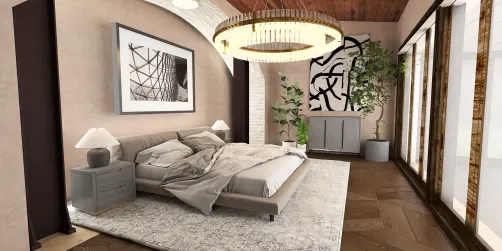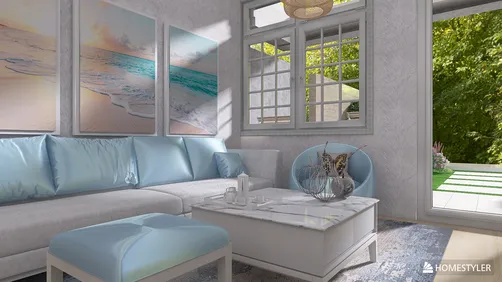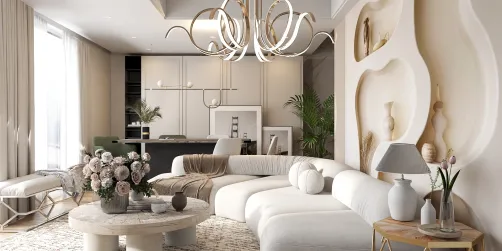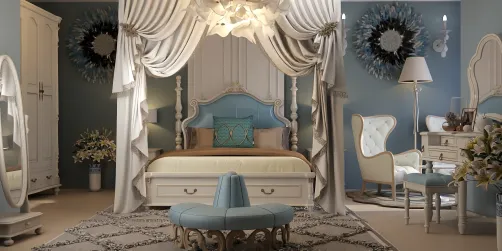
The evolving lifestyle is increasingly compressing time while broadening choices, leading today’s families to manage issues like circulation constraints and storage delays. As highlighted by NAHB surveys, a majority of buyers prioritize single-story living with two bedrooms, focusing on accessibility and the concept of aging in place. In my designs, every ground-floor two-bedroom house plan serves as a vision of a near-future living environment, optimized for reduced cognitive load and enhanced adaptability—because the future is rapidly approaching, and its outlines are becoming clearer. Using tools like Homestyler enhances spatial reasoning in these designs.
Split-Core with Offset Bedrooms
Design Principle: The public core is centrally located, with the bedrooms strategically placed in opposite corners to ensure privacy, particularly suitable for multigenerational living arrangements.
Flow: From the entrance, a drop zone leads into an open kitchen-living area, branching into a short hallway that directs guests and residents along separate paths to maintain privacy in living spaces.
Sightlines: A front-to-back axial view acts as a focal point for living, with bedrooms positioned off the main axis to minimize visual distractions.
Storage: Features include a wall-length pantry, hallway linen storage, and under-bench compartments, providing accessible storage options located near frequently used areas.
Furniture Arrangement: The design includes provisions for a 36" clearance for sofas, queen beds with 30" of space around them, and 72" dining setups, ensuring movement aligns with real-life usage.
Conclusion: This layout effectively organizes daily activities, making it future-proof for remote work and accommodating aging needs without requiring extensive redesign.
save pin
Courtyard Spine with Mirrored Bedrooms
Design Principle: Harnessing natural light is crucial; a narrow courtyard channels daylight through the home, with mirrored bedroom layouts to support circadian rhythms.
Flow: The layout begins at the entrance and follows the courtyard spine, connecting living areas at one end and bedrooms on either side, creating a clear and functional path.
Sightlines: The design features layered vistas—near (greenery), mid (living area), and far (sky)—ensuring intuitive privacy levels throughout the home.
Storage: Built-in cabinets along the spine provide distributed storage, with bedroom wardrobes placed close to bedroom entrances for convenience.
Furniture Arrangement: The plan supports low-profile sectional sofas, modular dining setups, and platform beds, all designed to fit within the corridor's spatial constraints.
Conclusion: This plan adapts to fluctuating climates, offering thermal and visual consistency—a calming environment amid changing circumstances.
save pin
Front Flex Room + Rear Primary Suite
Design Principle: The front-facing flexible space can be transformed into an office, guest accommodations, or studio space, while the primary suite is situated at the back, providing a tranquil escape from street noise.
Flow: The design leads from the entrance through the flex space into an open living area, with the kitchen serving as a functional hub for daily activities, culminating in the rear suite—ensuring smooth transitions without overlaps.
Sightlines: The entry provides a controlled perspective into the living area; the flex room acts as a sound buffer, while the rear suite offers a focused environment for peace and concentration.
Storage: Amenities include an entryway seating area with coat storage, a library wall in the flex room, and a spacious walk-in closet in the primary suite, supplemented by accessible attic storage.
Furniture Arrangement: The layout accommodates a worktable with a depth of 30", a Murphy bed for guests, and a king-size bed with a generous clearance of 36"—carefully planned for versatile use.
Conclusion: This configuration is built to accommodate gig-economy lifestyles and weekend gatherings, remaining flexible as family dynamics evolve over time.
save pin
## Final Thoughts
A ground-floor two-bedroom house plan conveys more than just square footage—it serves as an interface that effectively orchestrates energy, attentiveness, and seclusion. Variants like the split-core and courtyard-spine layouts illustrate how single-level designs can adapt to future requirements, ranging from home office setups to aging-in-place solutions. Based on my view, the most intelligent homes of the future won’t necessarily be larger—they will simply be more purposeful, and I continue to create them with tools like Homestyler.
Homestyler is your go-to online home design platform, perfect for transforming your ideas into reality. With its user-friendly design tool, stunning 3D renderings, and a wealth of DIY video tutorials, you can create beautiful spaces effortlessly. Start designing today!