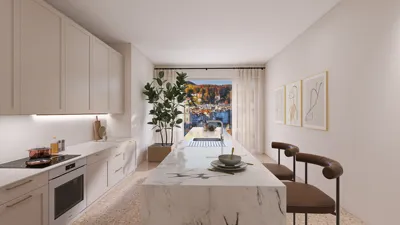
As we look toward the future, it's becoming evident that our current living spaces are revealing significant challenges, including storage constraints, disrupted flow, and a parked car area that feels isolated. Insights from AIA and NAHB trend observations indicate a strong and ongoing demand for adaptable spaces and protected parking options in mid-sized residences, underscoring the necessity for a 3-bedroom house plan complete with parking to operate as a cohesive unit. I interpret this layout as an early guideline for future family living—modular, frictionless, and subtly adaptable, much like a spatial reasoning toolkit.
Street-Courtyard Spine with Front Car Bay
Design Logic: The design integrates a front car bay that acts as a sound buffer from street noise, creating a welcoming space for arrivals; evolving trends suggest a preference for threshold layers that enhance shelter from weather, maintain privacy, and manage deliveries effectively.
Flow: The path flows from the car to a covered porch, leading through a utility area into the central kitchen hub, then to the living-dining space, and finally to the rear balcony, ensuring a seamless and efficient sequence without unnecessary backtracking.
Sightlines: Upon entry, diagonal views lead towards the dining area, framed by a window at the back; the car area is visually secluded through a slotted wall, creating a calming atmosphere in the home.
Storage: Practical sidewall cabinets within the car bay accommodate tools and EV equipment; a mudbench serves as a quick access point, while a deep pantry acts as effective cold storage to streamline weekly routines.
Furniture Fit: The 10 to 11-foot living area width supports a low-profile sectional sofa, with the dining space accommodating a 72" table; bedrooms are spacious enough to fit queen or king-size beds without impeding movement.
Verdict: This layout efficiently manages daily activities, functioning as a stable kernel—reliable, resilient, and ready for the demands of electric vehicle charging and a future with increased package deliveries.
save pin
Rear Tandem Parking with Garden Buffer
Design Logic: By relocating parking to the rear, the design allows for a serene facade and gives the living area room to breathe; it is also future-ready for accessory dwelling units and shared mobility hubs.
Flow: The routing goes from the alley to the tandem parking bay, leading through a service hallway into the kitchen island, then expanding into the living core, and finally reaching the bedroom area; all utilities efficiently share the same pathways.
Sightlines: There is a clear linear view from the kitchen island to the garden; the windows are designed like notifications, directing attention from the main living areas to greenery, the sky, and service spaces.
Storage: The design incorporates overhead storage racks in the tandem parking area; corridor closets function as a mid-point cache, and bedroom wardrobes are designed with a depth of 24 inches to align with storage routines.
Furniture Fit: The kitchen island measures 3x7 ft, while the sofa maintains a depth of 36 inches; children's rooms can accommodate twin beds with desks; versatile spaces can adapt between study and guest use without major changes.
Verdict: This layout epitomizes a soft-power approach: a serene facade coupled with a functional back area, and the garden serves as a thermal and social buffer for many winters to come.
save pin
Pod-Cluster Bedrooms with Semi-Internal Car Court
Design Logic: The semi-enclosed car court transforms into a small atrium, serving as a light well during the day and a secure entry point at night; bedrooms are arranged to form a clustered layout that minimizes latency.
Flow: The routing goes from the car court to a vestibule, then into a living ring before accessing the bedroom cluster; this circular design avoids dead ends, akin to a non-blocking network switch.
Sightlines: The design allows for views from the court through ribbed glass to the foyer; the living area opens laterally towards a pocket terrace, while staggered doors protect the sightlines in the bedrooms.
Storage: The wall of the court integrates vertical storage solutions; a linen storage spine runs through the pod; under-bed drawers offer quick access for seasonal items.
Furniture Fit: A radial coffee table keeps pathways clear; the master bedroom can accommodate a 78" bed without obstruction; desks are designed as compact 48" units suitable for hybrid work.
Verdict: In this layout, the car is not an unwanted presence but rather a well-calibrated neighbor; the home maintains a cooler, quieter, and safer environment, efficiently adapting to real-world needs.
save pin
Final Takeaway
A 3-bedroom house design with integrated parking is not merely a compromise; it is a unified interface where mobility, storage, and natural light interact seamlessly. Variants such as 3-bedroom configurations, homes with tandem parking, and compact bays designed for electric vehicles illustrate how form follows operational needs rather than mere aesthetics. Based on my observations, the most advanced homes in the future won't necessarily be larger—they will be more intentional in design, and I continue to use tools like Homestyler to craft spaces that behave like efficient, user-friendly systems.


Homestyler is your go-to online home design platform! With its user-friendly design tool, stunning 3D renderings, and a wealth of DIY video tutorials, you can effortlessly create and visualize your dream spaces. Perfect for both beginners and seasoned designers alike!