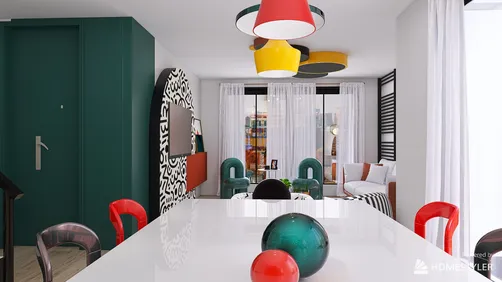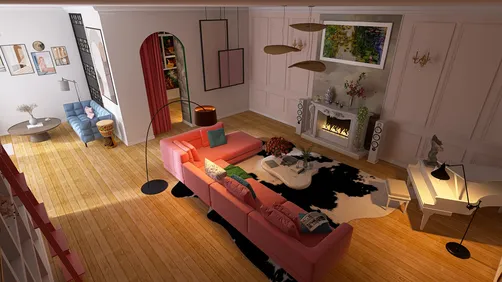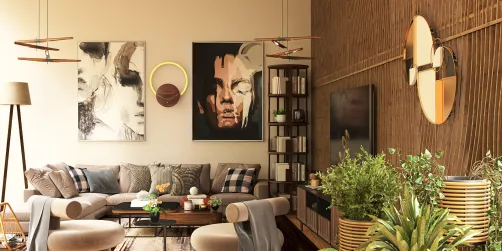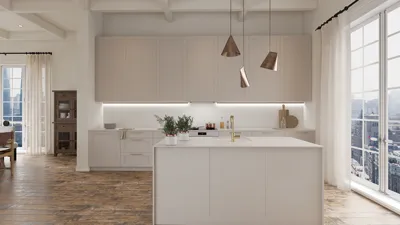
The work lifestyle of the future—characterized by hybrid models, asynchronous communication, and a focus on human interaction—addresses the current challenges of distractions, inflexible seating arrangements, and acoustic overwhelm. Insights from Houzz regarding workspace management reveal that flexible areas and control over lighting are frequent top choices for renovations. When designing an office layout suitable for groups of four, I conceptualize it akin to firmware for collaboration: steady, upgradable, and subtly adaptable. The future is emerging, and its features are already becoming apparent.
spatial reasoning toolkit
Quad Hub + Perimeter Commons
Design Insights: Four desks arranged in a central square maximize equal access without establishing hierarchy, while the periphery accommodates shared resources for focused tasks. Future teams will benefit from having a core for quick collaborations and boundary areas for concentrated work.
Flow: The design path leads from the entrance → coat/cable drop → quadrant seating → perimeter print/coffee area → window bench → huddle corner, establishing a seamless experience analogous to a clean program loop sans interruptions.
Sightlines: Low partitions maintain eye contact at a 15° angle; glass-front storage at the edges outlines a clear user interface: core = conversation, boundary = resources, and the window = status indicator.
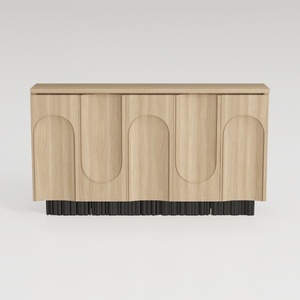
Storage: Perimeter credenzas serve as organized repositories with labeled bins, vertical files, and cable docks; the central area remains uncluttered to minimize cognitive load.
Furniture Specifications: Desks measure 60" x 30"; a central gap of 36" ensures clear movement; the credenza depth is 18"—these API parameters help maintain flow and ergonomic comfort.
Conclusion: This layout anticipates the hybrid work patterns: quick discussions in the core area, and silent activities along the edges. Over a five-year span, it sustains social connections while allowing for scalable peripherals.
save pin
Linear Runway + Acoustic Pods
Design Insights: A single run featuring four in-line workstations measuring 18–20 ft, complemented by two off-axis phone pods; this setup is designed to support video-heavy tasks while minimizing background noise.
Flow: The user journey follows entry → lockers → linear desks → pods → material shelving → terrace, designed like a structured pipeline with optional branches for added privacy.
Sightlines: A direct forward gaze and angled side views ensure that pod doors fall outside the main visual field, preventing UI noise from overwhelming communication.
Storage: Utilizing under-desk rolling files and wall-mounted grids, pods provide slim shelving for temporary storage to avoid cluttering the main pathway.
Furniture Specifications: Workstations are 54" x 28" with a 42" aisle; pods measure 3' x 4' internally; chairs can swivel within a 5' radius—ensuring precise movements that minimize latency.
Conclusion: This linear arrangement functions like an efficient data bus: reliable, quiet, and fast. Over time, it accommodates increased meeting demands without disrupting focus.
save pin
Pinwheel Stations + Shared Table
Design Insights: Four desks are arranged around a central point at a 45° angle, with staggered edges to reduce face-to-face fatigue; a communal project table anchors collaborative efforts.
Flow: Pathway flows from entry → whiteboard → pinwheel seating → shared table → sample rack → balcony; a cyclical design that encourages iterative testing.
Sightlines: The diagonal configuration layers visual information: the primary screen is in view ahead, while secondary signals from the team remain in peripheral observation; the whiteboard functions as a heads-up display.
Storage: Radial shelving and pegboards designate storage based on roles; the center remains clear to enhance throughput during high-intensity tasks.
Furniture Specifications: Desks are trapezoidal at 48"; center clearance measures 40"; the shared table spans 72" x 36"—this geometry serves to prevent collisions during peak usage.
Conclusion: This configuration is agile, tailored for teams engaged in pattern-making. Even five years ahead, it retains flexibility—the pinwheel design alleviates visual fatigue and the table accommodates complexity.
save pin
Final Takeaway
An office layout designed for teams of four prioritizes the systems that facilitate attention management, communication, and organization. Configurations like quad hubs, linear runways, and pinwheel setups express variations on the same theme. In my experience, the most effective future workplaces won’t necessarily be larger, but rather more intentional. What I consistently observe in my designs is that even minor adjustments in workflow can significantly reshape daily performance. Integrating tools like Homestyler can streamline such transformations, enhancing the overall office experience.
Homestyler is your go-to online home design platform! With its user-friendly design tool, impressive 3D rendering, and a wealth of DIY video tutorials, it empowers you to create stunning interiors effortlessly. Unleash your creativity and transform your space with ease!




















![Design [4]](https://hs-designs.homestyler.com/production/design/images/07c2de3a-88ec-4be8-8910-ff255b795bc2/1731419398293/7841697.jpg?x-oss-process=image/resize,w_502,m_mfit/format,webp)