As we look toward the future, urban families face challenges such as noise, limited storage, and disrupted routines. Hence, I craft designs with the foresight that the next five years will be integrated into today's planning. Current findings from the AIA highlight a growing preference for adaptable spaces rather than mere square footage—indicating that utility surpasses size. In Dwarka, a 4 bhk layout serves as the backbone for accommodating diverse generational needs, transforming it into a spatial reasoning toolkit. Using platforms like Homestyler can enhance this design process.
Axial Spine + Dual Courtyards
Design Concept: A central hallway functions as a spine, featuring living and dining areas on one courtyard and bedrooms on another, ensuring effortless flexibility for the future.
Flow: Transitioning from the entry to a mudroom, then flowing through living and dining to the kitchen node, leading to the spine and four bedrooms connecting to a tranquil terrace while avoiding cross-traffic.
Sightlines: Carefully layered from the entrance to the living area, with breaks in the kitchen for privacy control, culminating in a gradual opening to the terrace similar to user interface permissions.
Storage: Deep wall bays along the spine provide ample storage, with a pantry functioning as a cache, a linen tower located near bathrooms, and under-bed storage modules for quick access.
Furniture Configuration: Established circulation of 900–1000 mm maintains a clear path; modular sofa islands and 6–8 seat dining arrangements fit comfortably within the 3050–3300 mm bays for beds.
Conclusion: This design serves as a stable foundation where updates such as home offices, elder care spaces, and creative studios can be integrated smoothly without overhauling the entire layout.
save pin
Split-Master + Clustered Kids
Design Concept: A dedicated master suite ensures acoustic privacy, while the three clustered bedrooms position parental access and shared routines optimally.
Flow: Pathway flows from the lobby to the powder room, continuing to the living space, then the kitchen service area, leading to the master wing, connecting to the children's cluster, and ultimately to the shared bathroom and balcony.
Sightlines: The master suite's sightlines are restricted, while children's rooms open to a monitored axis, akin to role-based access within an organized user interface.
Storage: A walk-in space for the master suite, a shared wardrobe wall for the kids, and lockers near the entrance effectively manage daily clutter.
Furniture Configuration: The master suite accommodates an 1800 mm desk wall; children's rooms feature either bunk or twin beds with clear pathways of 800 mm; dining arrangements utilize a 2400 x 1600 island module.
Conclusion: This layout anticipates future growth, allowing study zones to transition into creative spaces while ensuring privacy remains thoughtful and adaptable.
save pin
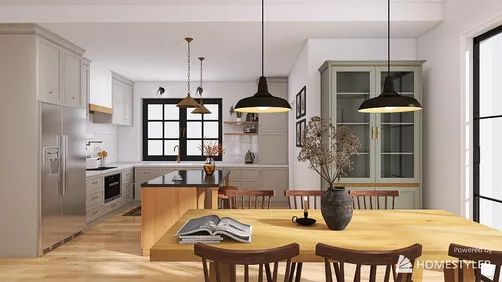
Hybrid Kitchen + Work Nook Loop
Design Concept: A semi-open kitchen connects to a compact work nook, allowing meal preparations and meetings to share space without noise distractions.
Flow: The design moves from entry storage to the living area, progresses through the semi-open kitchen to a breakfast bar, leading into the work nook, spine, bedrooms, and utility balcony circuit.
Sightlines: A bar-height shield conceals any mess from meal prep; views diagonal to the living area enable social interaction, with the work nook framed like a notification panel—visible yet focused.
Storage: Features include a vertical pantry, toe-kick drawers serving as micro-storage, overheads 600 mm deep, and utility walls that accommodate appliances.
Furniture Configuration: A spacious 1050 mm island clearance; task chairs fit neatly beneath a 1200 mm desk; sectional sofas are tailored to a 3000 mm façade grid.
Conclusion: This loop efficiently accommodates weekday activities and weekend gatherings, acting as a responsive circuit that evolves with changing needs.
save pin
Final Thoughts
In Dwarka, a 4 bhk floor plan transcends mere square meters; it serves as a dynamic interface where multi-generational routines harmonize like expertly written code. With adaptable bedrooms, hybrid kitchen spaces, and sightlines that strategically address privacy, homes evolve into detectable platforms for modern lifestyles. The long-term demands for features like a “multi-generational 4-bedroom layout” and a “hybrid kitchen workspace” have become essential specifications rather than optional extras. In my view, the most intelligent homes of tomorrow won’t necessarily expand in size—rather, they will be designed with greater intentionality, potentially utilizing tools like Homestyler to foster innovation.

Discover Homestyler, the ultimate online home design platform! With its user-friendly design tool, stunning 3D renderings, and a wealth of design projects and DIY video tutorials, transforming your living space has never been easier. Unleash your creativity and elevate your home design experience today!














![[For dear Adelina madee 🤎]](https://hs-designs.homestyler.com/production/design/images/8a07e535-9cbc-4132-a42a-5932dac3a112/1706972286037.jpg?x-oss-process=image/resize,w_502,m_mfit/format,webp)