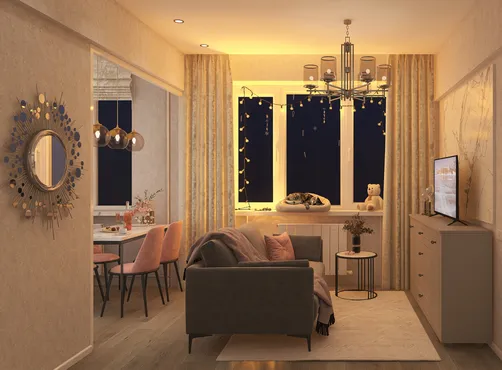
Year-End Reflective Living Space Design
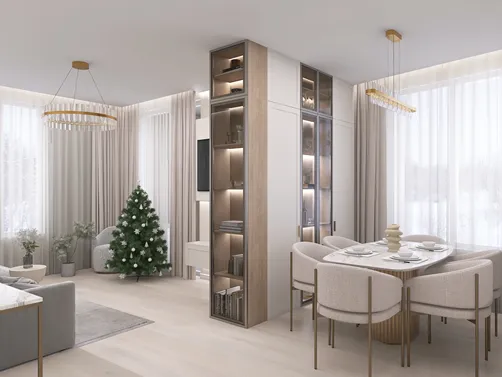
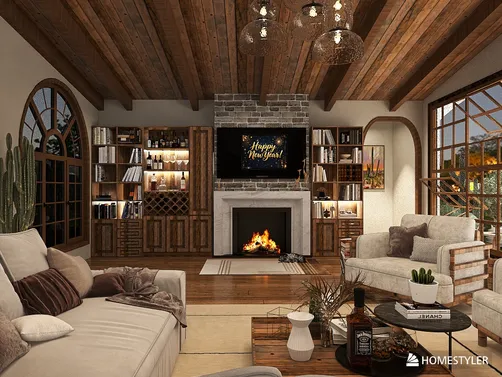
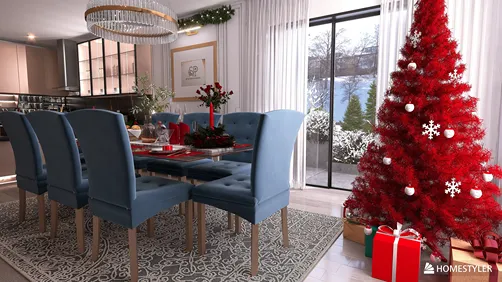
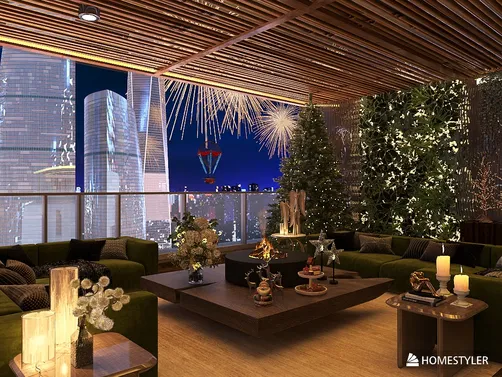
The 'Year-End Reflective Living Space' is a conceptual interior scene rooted in emotional storytelling and temporal symbolism — not defined by function (e.g., kitchen or bedroom) but by purpose: to mark closure, honor growth, and evoke anticipation. Drawing directly from the 'Goodbye 2025' contest theme — 'a space that captures your memories, growth, and hopes for the future' — this scene transcends conventional room typologies. It may manifest as a living-dining hybrid (as seen in Graca Doutel’s award-winning 'Ready for the Party'), an intimate lounge with fireplace and books (Sara Screm’s 'Addio 2025'), or a luminous café nook (Viktoriia V’s 'Goodbye 2025 Cafe'). Core to this scene is intentional atmosphere: layered lighting (candles, twinkle lights, ambient HDR renders), tactile material contrasts (stone + velvet, concrete + marble), symbolic objects (floating fireplaces, reflective surfaces, curated bookshelves), and chromatic palettes that balance warmth (gold, amber) with contemplative tones (deep navy, charcoal, winter-scape whites). It is a space designed for pause — where interior space planning serves narrative, and every element contributes to a personal year-end ritual.
Design Challenges & Common Pitfalls
Designing a Year-End Reflective Living Space presents unique challenges distinct from functional room design. First, balancing abstraction with authenticity: designers often over-symbolize (e.g., excessive clocks, calendars, or literal '2025' motifs), diluting emotional resonance. Second, lighting misalignment — using uniform brightness instead of dynamic, emotionally coded illumination (e.g., candlelight for nostalgia, cool moonlight for reflection) undermines mood coherence. Third, spatial ambiguity: without clear circulation or zoning cues (e.g., subtle rug boundaries, furniture groupings that imply gathering vs. solitude), the space feels unresolved rather than intentionally contemplative. Finally, tool limitation awareness: Homestyler’s 4-item tool cap means designers must prioritize high-impact elements (e.g., one signature light fixture + one textured wall + one symbolic object + one immersive HDR environment) — sacrificing decorative clutter for narrative clarity.
🎯 Emotional Anchoring Through Key Objects
Every reflective space needs at least one 'anchor object' — a singular, emotionally charged item that grounds the narrative (e.g., a floating fireplace, an open journal on a side table, a vintage globe, or a framed photo wall). This object should be visually prominent yet contextually integrated: placed at eye level, lit intentionally, and surrounded by negative space to invite focus. Avoid overcrowding; use Homestyler’s 'focus mode' to isolate and refine its materiality (e.g., adjusting stone texture roughness or velvet sheen) for maximum psychological weight.

Cecilia Botha’s 'Goodbye 2026' uses a bold, sculptural wall-mounted art piece as its emotional anchor — positioned centrally above a low velvet sofa, lit by focused downlight. She leverages Homestyler AI design tools to precisely calibrate the artwork’s scale relative to the window height and adjust the marble floor’s reflectivity to echo its frame, reinforcing memory and presence. Rather than adding multiple decorative items, she isolates this single object, allowing it to carry the entire farewell narrative — a masterclass in restraint-driven emotional anchoring within the 4-tool limit.
Start Free Designing💡 Layered, Mood-Driven Lighting Strategy
Lighting must operate on three simultaneous levels: ambient (base HDR environment, e.g., 'a_winter_snowscape' or 'moonlit_golf'), task (focused pools, e.g., reading lamp beside a chair), and accent (highlighting anchor objects or textures). Avoid flat 'room-wide' lighting. Instead, use Homestyler’s HDR library intentionally: 'shenzhen_night' for urban introspection, 'wuhan_night' for quiet warmth, or 'ljz_night' for celebratory transition. Combine with virtual light sources — candles near fireplaces, string lights overhead, or recessed LED strips under shelves — to create depth, rhythm, and temporal suggestion (dusk = reflection; twilight = hope).

Vanessa Ribeiro’s 'Design da Sala de Estar para a Passagem de Ano' demonstrates layered lighting mastery: the fireplace emits warm ambient glow ('g_ljz_day' HDR), while individual candles on the mantel and coffee table provide flickering task light, and delicate string lights in the ceiling create soft accent diffusion. Using Homestyler’s lighting adjustment panel, she fine-tuned candle intensity to avoid glare and aligned their color temperature with the HDR’s golden hour tone — transforming lighting from utility into emotional choreography for year-end transition.
Begin Free Design🧩 Material Contrast for Narrative Texture
Juxtapose at least two contrasting materials to embody the duality of farewell: permanence vs. transience, memory vs. possibility. Examples include raw concrete + polished brass, aged wood + translucent glass, or matte stone + iridescent ceramic. These pairings should be tactilely legible in renders — use Homestyler’s material editor to amplify grain, sheen, or weathering. Place contrasts strategically: a stone hearth beneath a floating timber shelf; velvet upholstery against metal-framed windows; or a silk pillow on a linen sofa. This isn’t decoration — it’s visual metaphor made physical through interior space planning.

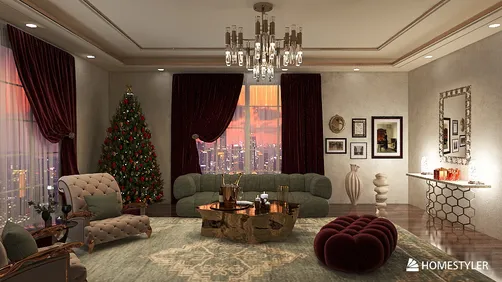
Cecilia Botha’s 'Goodbye 2025' pairs warm, supple leather seating with sharply detailed geometric wallpaper and a crystalline chandelier — a deliberate triad of texture, pattern, and light-refracting material. Within Homestyler’s design interface, she used the 'material swap' tool to test 12 leather variants before selecting one with visible grain and subtle patina, then adjusted the wallpaper’s scale to ensure rhythm without visual noise. This strategic material contrast doesn’t just look rich — it narrates resilience (leather), structure (pattern), and celebration (crystal) — all essential threads of a meaningful year-end reflection.
FAQ
Q: Do I need professional design experience to enter the Goodbye 2025 challenge?
Not at all. The contest celebrates personal expression — whether you’re a beginner or pro. Homestyler Design Tools offer intuitive drag-and-drop functionality, AI-powered style suggestions, and real-time rendering, making sophisticated interior space planning accessible to all.
Q: Can I submit more than one design?
Yes! You may submit multiple entries, but each must be a unique interpretation of the 'Year-End Reflective Living Space'. Use Homestyler Design Tips — like leveraging the 4-tool limit for maximum impact or choosing HDR environments that match your emotional intent — to differentiate concepts.
Q: How important is storytelling versus technical accuracy?
Storytelling is paramount. Judges prioritize emotional authenticity, symbolic coherence, and atmospheric resonance over perfect scale or construction detail. A deeply felt 'Addio 2025' lounge with intentional lighting and material contrast will outperform a technically flawless but emotionally neutral layout. Focus your interior space planning on narrative clarity.
Q: Are there restrictions on style or cultural references?
No restrictions — the contest explicitly states 'no style limitations'. Feel free to incorporate regional motifs (e.g., Italian 'Addio', Brazilian New Year rituals, Russian gold warmth), personal symbols, or abstract interpretations. Homestyler Design Tools support multilingual asset tagging and global HDR environments to help localize your vision.

Minimalist Fabric L Shaped Sectional Sofa 3D Model
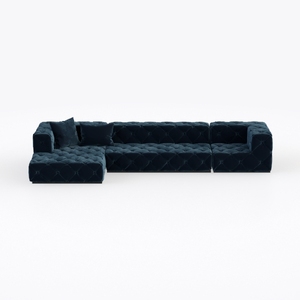
Modern Velvet Tufted L Shape Sectional Sofa 3D Model


Modern Minimalist Royal Blue Velvet L Shaped Sectional Sofa 3D Model
Homestyler is an easy-to-use online home design platform offering powerful 3D rendering, a vast collection of interior design projects, and helpful video tutorials. It’s perfect for anyone looking to create and visualize stunning home interiors effortlessly.
Дизайн сейчас бесплатно