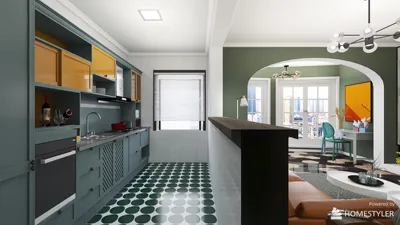


When it comes to designing children's rooms, I apply the same meticulous standards that I use for commercial spaces. The lighting must enhance vision, promote well-being, and positively influence behavior, all while incorporating creative elements. For effective visibility in reading areas, I adhere to the IES recommendation of 300–500 lux, reducing it to 100–200 lux for ambient play zones. Research from the WELL Building Standard highlights the importance of suitable lighting intensity and glare minimalization in alleviating visual fatigue and supporting circadian health. Therefore, I create wall lighting solutions that combine soft ambient washes with targeted accent lighting, ensuring that light sources are not directly in the child's line of sight. This approach is complemented by tools like Homestyler for visualizing the arrangement.
Color and rhythm are significant factors in children's environments. Studies compiled by Verywell Mind reveal that cool greens are soothing, blues enhance focus, and bright yellows can invigorate. In my designs, I incorporate soft 2700–3000K wall lights for a peaceful evening atmosphere, while 3500K accents assist in play and homework during the day. I also ensure that dimming features are consistently implemented to prevent overstimulation. For ergonomic purposes, sconces are installed with their lower edges positioned around 48–54 inches (120–137 cm) for school-aged children—high enough to deter manipulation yet low enough to provide even illumination across walls and ceilings. To facilitate nighttime navigation, I install lighting at about 1–5 lux along pathways, aligning with WELL guidelines to minimize exposure to bright light during nocturnal hours.
Essential Design Principles for Kids’ Wall Lighting
My lighting strategy for children's rooms is built on four key pillars: safety, visual comfort, adaptability, and creativity. When considering safety, I choose cool-to-the-touch enclosures, shatterproof diffusers, and UL-listed fixtures that feature tamper-proof cord management. Ensuring visual comfort begins with a layered approach that includes diffused wall washers for soft ambiance, shielded sconces for task lighting, and low-glare night lights. Adaptability is catered for through the use of dim-to-warm LEDs, exchangeable shades, and versatile backplates that can change alongside the evolving interests of children. Creativity takes shape in the fun aspects of design—such as light fixtures that tell stories, color-changing accents with capped brightness levels, and lights that add texture to the walls without causing harsh hotspots. Utilizing tools like Homestyler can help visualize these concepts in a real room setting.
Prioritizing Safety: Durable Wall Sconces for Kids
In spaces designed for infants and toddlers, I recommend using enclosed, impact-resistant fixtures with rounded edges. I steer clear of exposed bulbs and select LEDs that maintain surface temperatures well below hot thresholds. It's best to install switched fixtures over dangling pull chains; if cords are unavoidable, they are secured behind furniture or within cord covers. All finishes should be low-VOC, and, whenever feasible, I opt for interchangeable LED modules over enclosed units to enhance sustainability and longevity—harmonizing eco-friendliness with practicality.
The Impact of Color, Mood, and Light Temperature
Understanding color psychology is crucial when designing for young children. I favor warm white lighting (2700K–3000K) during bedtime, neutral whites (3000K–3500K) for playtime, and limit RGB usage strictly to accent lighting. Should I incorporate color-changing backlighting, I ensure that saturation and brightness levels are moderated to avoid overstimulation while maintaining clear navigational paths. By softly grazing light over textured surfaces like paint or felt panels, I aim to produce depth without glare, cultivating a nurturing atmosphere.
Innovative Wall Lighting Concepts for Playful Environments
Imagine designs inspired by moons, clouds, rockets, or animal shapes, with indirect LED strips discreetly mounted behind these forms. This setup produces a halo effect, doubling as a night light while keeping luminosity between 50–100 lumens for nighttime needs. Additionally, a shallow, wall-mounted magnetic mini-track allows for flexible positioning of tiny spot modules or diffuse lighting as a child matures. In reading corners, I integrate a focused beam module of 15°–24° aimed right at the book surface, accompanied by a broader diffuser for ambient illumination.
In addition, up-light sconces effectively bounce light off ceilings, visually enlarging smaller rooms while diminishing reflections on glossy items like books or tablets. Implementing a matte ceiling (≤10 GU) aids in diffusing return light more evenly. I can also conceal linear lighting behind a trim rail or gallery strip for a customizable art display where kids can hang their creations. Using a high Color Rendering Index (CRI) source ensures colors are true to life without the glare typically found in gallery settings.
Securely mounting a world map or pegboard, and utilizing low-glare linear lighting, transforms the grid into a dynamic learning surface. Dimming options for various activities, such as ‘study,’ ‘play,’ and ‘wind-down’ modes, enhance versatility. A rotating, pivoting sconce shielded to achieve a cutoff angle of ≥30° helps keep glare out of young eyes, aiming for 300–500 lux where books are placed, with easy-to-reach switches promoting independence for children.
Install a slim, dimmable floodlight near the base to produce playful oversized hand shadows during leisure time. Pair this with wipeable paint so that silhouettes can feature themes from decals or stencils. For safe nighttime movement, ultra-low output nodes along the baseboards with motion sensors enable gentle illumination without triggering overly bright room lighting.
Organizing the Room Layout Effectively
I begin with a straightforward zoning approach, identifying sleep, play, study, and circulation sectors. Each zone receives its designated wall-lighting layer and control function. To visualize glare and light gradient spill, I find that quick digital mockups using room design visualization tools such as Homestyler facilitate testing sightlines. It's vital to maintain a safe distance from bunk beds, keeping fixtures at least 18 inches (45 cm) away from pillows, and ensuring no obstructions for door swings or access to storage. Cable management is a priority, with routing that remains inaccessible to small hands.
Managing Glare and Enhancing Visual Comfort
Children are especially susceptible to high contrast and glaring light. I opt for deeper optical cutoffs, gently frosted diffusers, and indirect lighting strategies. When working with glossy paint finishes, wide wall washers are preferred to minimize shiny reflections instead of tight beams. For shared sibling rooms, having individual switches on each side can help to personalize bedtime routines and lessen potential conflicts.
Materials, Sustainability, and Simplicity of Maintenance
In children's areas, fixtures need to be easy to clean— powder-coated metals, sealed fabrics, and closed-cell felt make ideal choices. When implementing acoustic felt panels behind wall washers, these elements enhance visual and acoustic comfort simultaneously. I seek out replaceable LED boards or standardized bases for longer product lifespans, and ensure finishes can withstand frequent cleaning.
Control Systems That Evolve with Children
Simplicity is key. I recommend programming three fundamental scenes: Play (3500K, 70–100% brightness), Study (3500K, 60–80% brightness with task accents), and Wind-Down (2700K, 5–25%). There is also a dedicated night mode set at 1–5 lux. As children mature, incorporating dim-to-warm sconces can preserve bedtime rituals while enhancing functionality for tasks.
Designing for Small Rooms and Shared Spaces
For compact areas, wall-mounted lighting frees up surfaces and creates the illusion of a larger space. Implementing up-light sconces and light grazing along the perimeter brightens ceilings, contributing to a feeling of height. In shared rooms, each bed should be equipped with its own sconce featuring local dimming and narrow beams, allowing one child to read without illuminating the entire space.
Cost-Effective Solutions
Concentrate on a small number of impactful wall lights and layer in budget-friendly plug-in accents using cord covers. Implementing a single dimmer to control two matching sconces provides flexibility, while also designating one high CRI 90+ fixture for the area where color accuracy is of utmost importance—like art or reading zones.
Installation Considerations
For hardwired sconces, spacing them 5–7 ft (150–213 cm) apart along lengthy walls ensures a harmonious distribution. I adjust placements to prevent interference with headboards and storage. It’s crucial to use child-safe fasteners and ensure junction boxes are properly flush to the wall. In plasterboard installations, I either add blocking or use rated anchors for enhanced durability.
Referencing Standards and Studies
For guidance on light levels and visual comfort, I rely on specifications set by the Illuminating Engineering Society (IES) and consult WELL v2 recommendations for circadian-friendly lighting intensity and timing. To understand how color affects mood, I reference educational summaries from Verywell Mind. These benchmarks support the optimization of children's wall lighting for safety, comfort, and delight.
Frequently Asked Questions
Q1. What illumination levels are ideal for a child's reading area?
A1. Aim for 300–500 lux on the page using a shielded sconce or adjustable spotlight. Also, balance this with softer ambient light to maintain a comfortable contrast ratio while minimizing glare.
Q2. What color temperature is suitable for bedtime?
A2. Opt for warm white lighting around 2700–3000K on dim settings, as it fosters relaxation and reduces alertness in comparison to cooler tones, especially when used alongside low overall illumination.
Q3. Are RGB color-changing wall lights appropriate for kids?
A3. Yes, but they should only be used as accent lighting. The brightness should remain moderate and saturated colors should be avoided in the evening hours. Providing a warm white preset for reading and winding down ensures visual comfort is maintained.
Q4. How can glare and hotspots be mitigated?
A4. Choose sconces with diffusers or deep cutoffs, avoid any exposed filaments, and utilize matte wall finishes. Indirect up-lighting or wall washers contribute to creating soft, uniform brightness throughout the room.
Q5. What is the safest mounting height for sconces?
A5. For older kids, position the bottom of the sconces at approximately 48–54 inches (120–137 cm), ensuring fixtures are at least 18 inches (45 cm) from pillows and away from any climbing paths or edges of bunk beds.
Q6. How can lighting accommodate both play and study activities?
A6. Establish distinct scene settings: Play at 3500K with higher brightness, Study with task accents achieving 300–500 lux, and Wind-Down at 2700K with low dim levels. A single dimmer with memory functions simplifies the process.
Q7. Which materials are durable for children's rooms?
A7. Opt for powder-coated metals, sealed diffusers, and closed-cell felt for backing. In areas displaying art and books, strive for a CRI of 90+. Refrain from using fragile glass or exposed filament bulbs.
Q8. How should I approach lighting in a smaller kids’ room?
A8. Implement wall-mounted up-lighting and perimeter grazing to enhance ceiling brightness and increase floor space. You can balance illumination by positioning mirrors opposite windows to create an even light distribution.
Q9. Is nighttime lighting necessary?
A9. Having low-level pathway lights (1–5 lux) activated by motion sensors is beneficial for safe nighttime navigation without disruptive brightness. These light sources should remain shielded and placed low to the ground.
Q10. Can I add lighting to showcase kids’ artwork?
A10. Absolutely. A linear wall washer with a CRI of 90+ can gently illuminate an art display without causing glare. Ensure it’s mounted out of reach and include a dimmer for adaptive lighting scenes.
Q11. What about smart lighting controls?
A11. Aim for simplicity by using two to three tailored scenes and locking maximum brightness for evening use. Battery-operated remotes or child-height wall controls promote user independence.
Q12. How can I reduce noise while illuminating the walls?
A12. Pair wall washers with acoustic felt panels to enhance texture illumination while absorbing sound, ultimately improving auditory comfort for both play and reading areas.


Looking to transform your home? Homestyler is your go-to online design platform! Enjoy an easy-to-use design tool, impressive 3D renderings, and a wealth of inspiring DIY tutorials and design projects. Bring your vision to life effortlessly, regardless of your experience level!
Дизайн сейчас бесплатно
































