Spring Healing Aesthetic Decoded: Natural Warmth Meets Seasonal Joy
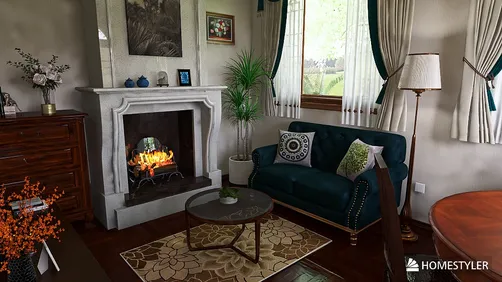
The 'Spring Healing' aesthetic—born from Homestyler’s global design challenge—is not a rigid style, but a sensory philosophy rooted in seasonal renewal and biophilic calm. It responds to the Northern Hemisphere’s spring transition with intentionality: inviting light, celebrating growth, and grounding interiors in nature’s quiet authority. Unlike trend-driven minimalism or maximalist eclecticism, this aesthetic prioritizes emotional resonance over visual noise. Its core directive is healing—not just through color or form, but through material honesty, chromatic softness, and spatial generosity. Wood isn’t veneer; it’s grain-rich oak flooring under bare feet. Ceramics aren’t decorative accents—they’re hand-thrown mugs holding chamomile tea beside sunlit windows. Rattan isn’t a passing texture—it’s a woven headboard breathing warmth into a bedroom. This is interior design as restorative ritual: where cherry blossom pink whispers optimism, fresh greens pulse with vitality, and earthy tones—think terracotta, oat, and moss—anchor the space in grounded serenity. Crucially, it’s highly adaptable: equally powerful in a 25m² Neo-Memphis studio (as seen in Marina Arkhireeva’s award-winning entry) or a sprawling 1180m² family home (Alaz Su Cebe’s top-3 submission), proving that healing spaces scale with empathy, not square meters.

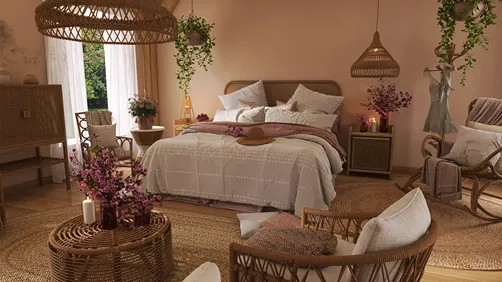
Rirri Turtakova’s 'Spring Healing room' exemplifies this aesthetic’s accessible elegance. In Homestyler’s 3D environment, she leverages natural light simulation (HDR: g_autumn_park) and large-window presets to flood the space with warmth—no post-processing needed. Her palette—plush pink bedspread against warm wood tones—is built using Homestyler’s intuitive color picker and material library, where cotton duvets and ceramic bedside lamps are one click away. The result? A space that feels instantly lived-in and emotionally safe—achievable by beginners and pros alike using Homestyler’s drag-and-drop realism.
Design Your Cozy Room🌿 Natural Material Harmony
This aesthetic mandates the intentional use of *at least three* natural materials—not as props, but as structural storytellers. Wood provides warmth and grain depth (floors, frames, shelving); rattan introduces organic texture and airy lightness (chairs, pendant lights, wall panels); cotton delivers tactile softness and breathable comfort (upholstery, curtains, bedding); ceramics add grounded weight and artisanal soul (vases, tableware, sinks). Their synergy creates multisensory authenticity: the cool smoothness of ceramic next to the nubby warmth of cotton, all anchored by the enduring presence of wood. Homestyler’s material library makes this effortless—each category is tagged, searchable, and rendered with photorealistic fidelity, allowing designers to preview how light catches rattan weaves or how cotton diffuses morning sun.
Rirri Turtakova’s bedroom masterfully layers these materials: a solid oak bed frame grounds the composition; a cotton-linen duvet invites touch; a ceramic table lamp adds sculptural weight on the nightstand; and subtle rattan drawer pulls introduce textural rhythm. In Homestyler, selecting each was streamlined—she used the 'Natural Materials' filter, applied realistic textures with one click, and adjusted lighting intensity to highlight their inherent qualities, proving that material richness requires no complex modeling—just smart tool use.
Start Your Natural Space🌸 Chromatic Vitality & Soft Contrast
Color here is botanical, not decorative. Fresh greens—sage, mint, and eucalyptus—symbolize growth and clarity. Cherry blossom pinks—blush, petal, and shell—are delicate, never saccharine, evoking new buds and gentle optimism. Earthy tones—oat, clay, mushroom, and warm taupe—provide essential balance, preventing the palette from feeling fleeting or overly sweet. Crucially, contrast is soft: no harsh black/white binaries. Instead, tonal layering prevails—e.g., sage walls + blush cushions + oat rug—creating depth through nuance, not drama. Homestyler’s color harmony tools auto-suggest complementary palettes based on uploaded mood boards or even single reference images, accelerating the shift from concept to cohesive scheme.

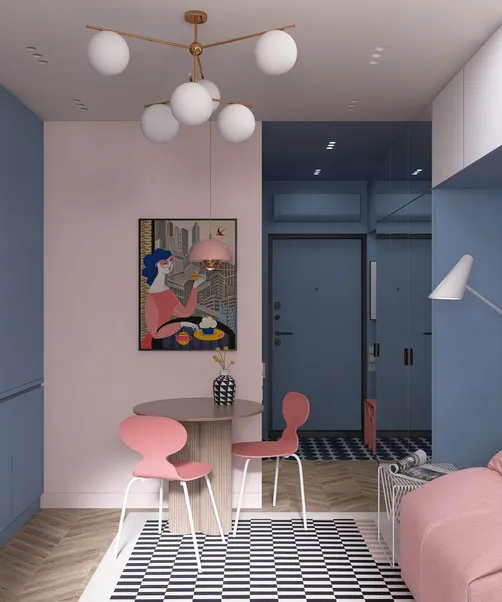
Marina Arkhireeva’s 'Neo-Memphis studio apartment' reinterprets chromatic vitality with bold confidence. While most entries lean into softness, hers uses cherry blossom pink as a vibrant anchor—paired with saturated teal and mustard—yet maintains healing intent through abundant greenery and natural rattan furniture. In Homestyler, she achieved this balance by leveraging the 'Sunlight Intensity' slider and HDR environment 'g_ljz_day' to ensure colors remained vivid but never glare-prone, demonstrating how the platform empowers both serene and spirited interpretations of the same theme.
Create Soft Color Scenes☀️ Light-Centric Spatial Flow
Light isn’t an afterthought—it’s the primary design element. Large windows, glass partitions, and reflective surfaces (polished wood, glazed ceramics) are employed to maximize daylight penetration and diffusion. Spaces are arranged to follow the sun’s path: seating zones face east for morning energy; reading nooks nestle in south-facing corners; bedrooms embrace west-facing glow for calming evenings. Natural light also activates the palette: it makes greens feel alive, softens pinks into warmth, and deepens earthy tones into richness. Homestyler’s real-time sunlight simulation—with adjustable time-of-day, season, and sky conditions (e.g., 'g_sunny_vondelpark')—allows designers to test layouts for luminosity *before* construction, turning light from variable to controllable design tool.

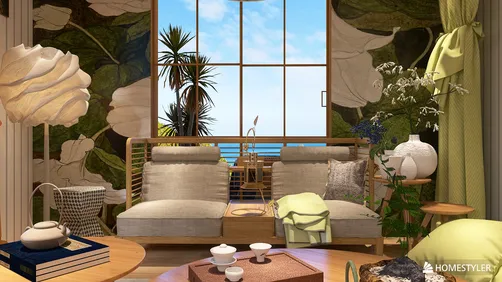
Amy ✨’s 'Project: Spring Healing (2)'—a Japanese-inspired tea house—exemplifies light-centric flow. Sliding shoji screens and an indoor pond reflect and diffuse light, while the open connection to the garden blurs interior/exterior boundaries. In Homestyler, she used the 'Glass Partition' asset and set the HDR to 'g_nooutdoor' to simulate seamless garden integration. The result is a space where light doesn’t just illuminate—it connects, calms, and heals. Homestyler’s ability to render dynamic reflections and ambient occlusion made this ethereal quality achievable without advanced rendering software.
Вызовы в дизайне VistFAQ
Q: What are the mandatory material requirements for the Spring Healing aesthetic?
A: Designers must incorporate at least three distinct natural materials—such as wood, rattan, cotton, linen, jute, bamboo, or ceramics. These must be visibly integrated into the structure or furnishings (e.g., a rattan chair, ceramic sink, cotton sofa upholstery), not merely as small decorative objects. Homestyler’s material tagging system makes compliance easy—filter by 'Natural' and apply with one click.
Q: Can I submit a Spring Healing design if I’m new to 3D interior design?
A: Absolutely. Homestyler’s intuitive interface, pre-built templates (like 'Sun-Filled Bedroom' or 'Conservatory Layout'), and AI-powered suggestions lower the barrier significantly. Wendy Callaway’s award-winning 'Spring Conservatory' was created using only four tools—proof that expressive, healing spaces don’t require technical complexity.
Q: How does Homestyler help me achieve authentic natural light in my Spring Healing render?
A: Homestyler offers real-time, physics-based sunlight simulation. Adjust time-of-day, season, geographic location, and HDR environment (e.g., 'g_ljz_day', 'g_sunny_vondelpark') to preview exactly how light will interact with your chosen woods, ceramics, and textiles—ensuring your space feels genuinely sun-kissed and alive.

Minimalist Solid Wood Platform Bed With Slatted Headboard 3D Model

Minimalist Solid Oak Wood Platform Bed With Bedding 3D Model

Homestyler offers an easy-to-use online home design tool complete with stunning 3D renderings, inspiring design projects, and helpful DIY video tutorials. It’s perfect for bringing your interior decoration ideas to life quickly and creatively.
Дизайн сейчас бесплатно